Cheap solo ads can look like the easiest way to stretch an advertising budget. A vendor offers hundreds of clicks at a low price, and the numbers immediately seem attractive. But a low upfront price does not always mean a low overall cost.
The real question is whether cheap solo ads generate relevant visitors, qualified leads, customers, and profitable revenue. If the traffic does not convert, the money saved on clicks can quickly disappear through wasted follow-up, weak leads, and missed sales opportunities.
In this guide, you’ll discover seven hidden problems to check before choosing cheap solo ads and learn how to determine whether a low-cost campaign is actually worth your investment.
Table of Contents
Compare the Total Cost, Not Just the Click Price
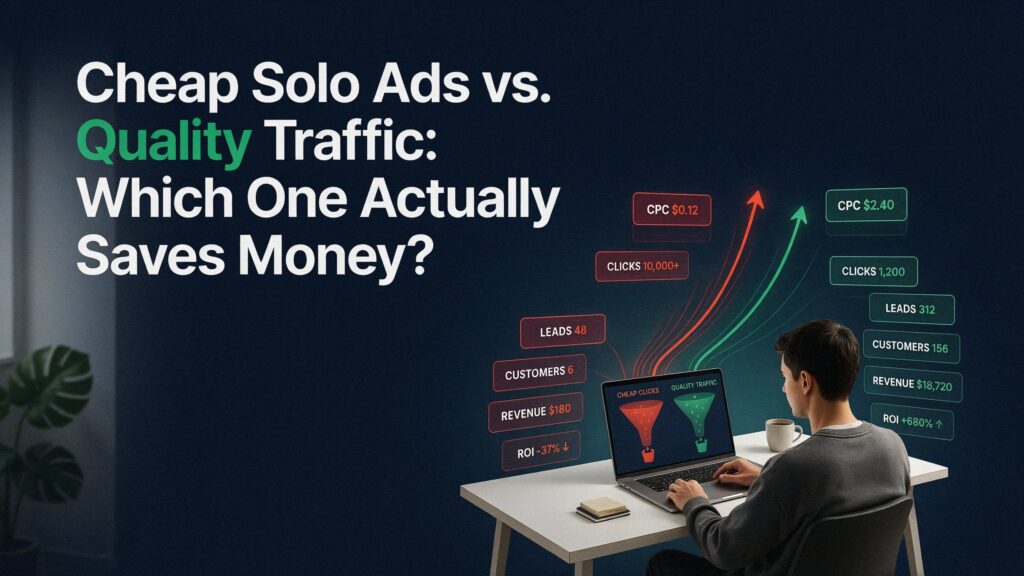
When marketers compare cheap solo ads, they often focus only on the price per click. For example, Vendor A might offer 500 clicks for $100 while Vendor B charges $200 for the same number of clicks.
At first glance, Vendor A appears to be the better deal.
But what happens after those clicks arrive?
Consider this example:
Vendor A:
- Cost: $100
- Clicks: 500
- Leads: 25
- Customers: 2
- Revenue: $80
Vendor B:
- Cost: $200
- Clicks: 500
- Leads: 100
- Customers: 12
- Revenue: $600
Vendor A costs less, but Vendor B produces significantly more customers and revenue.
This is why the initial price should never be the only factor when evaluating traffic. You need to consider the complete customer acquisition process, including your landing page, email follow-up, product costs, and sales performance.
A useful formula is:
Total Acquisition Cost = Ad Cost + Funnel Costs + Follow-Up Costs + Other Marketing Expenses
A low-cost click can become expensive if it requires a large amount of additional work to produce a customer.
Instead of asking, “How cheap are these clicks?” ask, “How much will it actually cost me to acquire a customer?”
That small change in perspective can dramatically improve your advertising decisions.
Cheap Solo Ads Can Create Expensive Lead Problems
One of the biggest problems with cheap solo ads is poor lead quality.
A campaign might generate hundreds of visitors and dozens of subscribers, but those numbers do not necessarily represent valuable prospects.
Imagine purchasing 1,000 clicks and receiving 200 new subscribers. That sounds impressive until you discover that:
- Most subscribers never open your emails.
- Very few click your offers.
- Almost nobody responds to your messages.
- Only one or two people eventually purchase.
Your lead count looks impressive, but the actual business value is extremely low.
This can happen when traffic comes from an audience that has little connection to your niche.
For example, if you sell an email marketing course, traffic from subscribers interested in digital marketing, lead generation, or online business may be more relevant than a broad audience attracted by generic money-making claims.
Before purchasing traffic, ask the vendor about:
- Audience niche
- Subscriber interests
- Traffic sources
- Engagement levels
- Geographic targeting
- Previous campaign performance
You can also ask whether the vendor has experience with offers similar to yours.
Quality traffic should have a logical connection to your product. If the audience is completely unrelated, even a large number of clicks may produce disappointing results.
Cheap Solo Ads May Have Lower Conversion Rates
Before buying cheap solo ads, ask whether the audience is genuinely interested in your offer.
Traffic only becomes valuable when visitors take an action that moves your business forward.
That action might be:
- Joining your email list
- Downloading a lead magnet
- Booking a consultation
- Starting a free trial
- Purchasing a product
- Requesting additional information
Consider two campaigns.
Campaign A:
- Cost: $100
- Visitors: 1,000
- Opt-in rate: 1%
- Leads: 10
Campaign B:
- Cost: $200
- Visitors: 500
- Opt-in rate: 20%
- Leads: 100
Campaign B costs twice as much but produces ten times as many leads.
This demonstrates why the cheapest traffic is not automatically the most efficient traffic.
Your landing page also matters. If your page normally converts at 20% but traffic from one vendor converts at only 2%, investigate the source before assuming that your entire funnel is broken.
At the same time, do not automatically blame the vendor. Your headline, offer, page speed, design, message match, and call-to-action can all influence conversions.
The best approach is to test systematically and compare results using the same offer and landing page.
Poor Traffic Can Increase Your Follow-Up Costs
Another hidden cost of cheap solo ads is the amount of time and money required to follow up with low-quality leads.
Every new subscriber enters your email system. That can create additional costs for email software, automation, content, customer support, and marketing management.
Suppose you generate 1,000 new subscribers from a low-cost campaign.
If those subscribers are highly engaged, the additional email costs may be worthwhile because they have potential customer value.
But if most subscribers never open your emails, your list grows without producing meaningful revenue.
Over time, this can create several problems:
- Lower overall engagement
- More inactive subscribers
- Higher email platform costs
- More time spent managing unresponsive leads
- Less reliable audience data
This is why lead quantity should never be the only success metric.
You can also improve the value of your traffic by creating a structured funnel. For example:
Solo ad → Lead magnet → Welcome sequence → Educational emails → Product offer
A clear follow-up process gives new subscribers multiple opportunities to understand your offer and build trust.
If you want to understand how traffic can be turned into customers through a structured process, see From Click to Customer: Building a Solo Ads Funnel That Works.
The goal is not simply to acquire more leads. It is to acquire leads that are worth nurturing.
Cheap Traffic Can Hide a High Customer Acquisition Cost
Another important issue is customer acquisition cost, or CAC.
You might have a low cost per click and even a low cost per lead, but still have an expensive customer acquisition process.
For example:
Campaign A:
- Ad spend: $150
- Leads: 100
- Customers: 5
- Customer acquisition cost: $30
Campaign B:
- Ad spend: $250
- Leads: 125
- Customers: 20
- Customer acquisition cost: $12.50
Campaign A has the cheaper leads, but Campaign B produces customers at less than half the acquisition cost.
This is why cheap solo ads can create a false sense of efficiency.
A low cost per lead does not necessarily mean that your campaign is profitable.
Instead, track the entire journey:
Click → Lead → Customer → Revenue → Profit
If your average customer produces $50 in profit and costs $20 to acquire, the campaign may be sustainable.
But if the customer produces $30 in profit and costs $40 to acquire, you are losing money regardless of how inexpensive the original clicks were.
Your real target should be profitable customer acquisition—not simply inexpensive traffic.
Measure Cheap Solo Ads Against Revenue and ROI
Tracking is essential when evaluating cheap solo ads.
Clicks and leads are useful indicators, but revenue and return on investment provide a much clearer picture of campaign performance.
A simple ROI formula is:
ROI = (Revenue − Cost) ÷ Cost × 100
For example:
Ad cost = $300
Revenue = $900
ROI = ($900 − $300) ÷ $300 × 100
ROI = 200%
Now compare that with another campaign:
Ad cost = $150
Revenue = $200
ROI = ($200 − $150) ÷ $150 × 100
ROI = 33.3%
The second campaign was cheaper, but its financial performance was dramatically weaker.
You should also distinguish between revenue and profit. Additional expenses may include:
- Product fulfillment
- Affiliate commissions
- Payment processing
- Email software
- Landing-page software
- Customer support
- Refunds
When these expenses are included, you get a more realistic picture of campaign profitability.
For broader campaign measurement, Google Analytics provides guidance on using campaign parameters to identify where website traffic comes from. You can use Google’s guide to campaign URL builders and UTM parameters to improve campaign attribution and compare traffic sources more accurately.
Better tracking helps you identify which campaigns are actually generating business value.
Test Before You Scale Your Budget
The best way to evaluate cheap solo ads is to test before scaling.
Instead of spending your entire budget on one campaign, start with a smaller test.
For example:
Step 1: Choose one vendor.
Step 2: Use one offer.
Step 3: Send traffic to one landing page.
Step 4: Create a unique tracking link.
Step 5: Measure clicks, leads, engagement, sales, and revenue.
Step 6: Compare the results against your target numbers.
Step 7: Scale only if the campaign demonstrates acceptable performance.
Suppose you spend $50 on a small test and discover that the traffic produces many clicks but almost no opt-ins. You can investigate the problem without risking hundreds or thousands of dollars.
If the traffic generates strong engagement and conversions, you have evidence that scaling may be worthwhile.
Testing also makes vendor comparisons easier.
For example:
Vendor A:
- 300 clicks
- 45 leads
- 3 customers
Vendor B:
- 300 clicks
- 70 leads
- 8 customers
Vendor B may be the better source even if its clicks cost more.
This is the key lesson: don’t scale based on promises. Scale based on measurable performance.
Conclusion
The attraction of cheap solo ads is obvious. Lower prices can make it easier to test traffic and stretch a limited advertising budget.
But the cheapest option is not always the most profitable.
Poor lead quality, low conversion rates, wasted follow-up, high customer acquisition costs, and weak ROI can quickly turn an inexpensive campaign into an expensive mistake.
Instead of asking only how much a click costs, evaluate the complete customer journey.
Look at:
- Traffic relevance
- Lead quality
- Conversion rates
- Customer acquisition cost
- Revenue
- Profit
- ROI
Then test small campaigns before increasing your budget.
The best traffic is not necessarily the traffic with the lowest price. It is the traffic that produces relevant visitors, qualified leads, customers, and measurable profit.
FAQs
Are cheap solo ads always low quality?
No. A low price does not automatically mean poor traffic. The important factors are audience relevance, engagement, conversion performance, and the overall return generated by the campaign.
How can I test a new solo ad vendor?
Start with a small campaign, use a unique tracking link, and measure clicks, opt-ins, engagement, sales, and revenue before increasing your budget.
What is more important: cost per click or cost per customer?
Cost per customer is generally more useful for judging profitability because it shows how much you actually spend to acquire a paying customer.
Why can low-cost traffic become expensive?
Low-cost traffic can become expensive when visitors are poorly targeted, fail to convert, require extensive follow-up, or produce very few customers.
How do I calculate customer acquisition cost?
Divide your total marketing and acquisition expenses by the number of new customers generated during the campaign.
Customer Acquisition Cost = Total Acquisition Cost ÷ New Customers