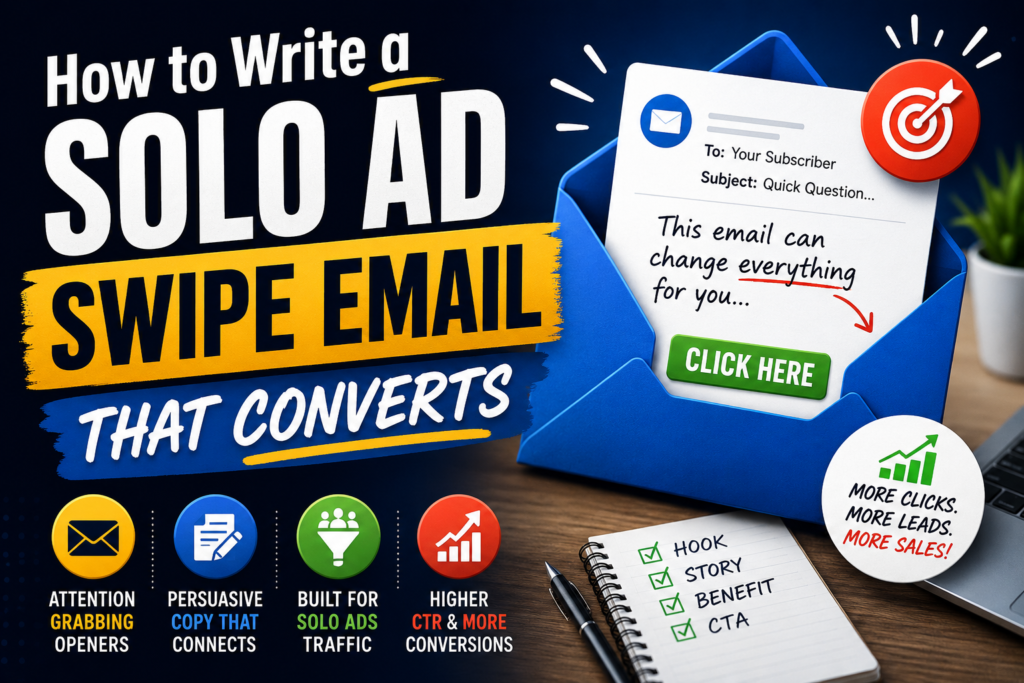
Most people who buy solo ads for the first time end up feeling like they threw money into a black hole. They spend hundreds of dollars on clicks and watch their tracking software show plenty of activity but zero actual results. The problem usually isn’t the traffic quality or the vendor you chose. Most of the time, the failure happens because your email copy failed to bridge the gap between a stranger and your offer. Learning how to write a solo ad swipe email that converts is the difference between building a massive list and going broke.
You have to realize that solo ad traffic is unique compared to search or social media traffic. These people are already on someone else’s email list and they are used to seeing dozens of offers every single day. If your email looks like every other generic pitch in their inbox, they will ignore it. You need a specific strategy to grab their attention and force them to take action.
Table of Contents
The Real Reason Your Current Email Swipes Are Failing
Here is the thing that most beginners miss when they start out. They take the pre-written swipes provided by their affiliate program and send them directly to a solo ad vendor. These generic swipes are often written by people who don’t actually buy solo ads. They are designed for general email marketing and often lack the punch needed for cold, fast-moving traffic.
Honestly, the vendor’s subscribers have likely seen that exact same affiliate swipe a dozen times before. When they see the same subject line and the same opening sentence, their brain shuts off. They know exactly what is coming and they don’t even bother clicking. For example, if you send 500 clicks using a stock affiliate swipe that has been circulating for three years, you might see an opt-in rate as low as 15% because the audience is bored of the message.
If you rewrite that same message to be unique and personal, you can easily double that conversion rate. You need to stand out by being different from the noise. The goal of your swipe isn’t to sell the product yet. The only job of your email is to sell the click to your landing page.
The Psychology Of The Click In Solo Ad Marketing
You have to understand the mental state of the person reading your email. They are likely scanning their inbox while waiting for coffee or during a quick break at work. They are looking for a reason to delete your email, not a reason to read it. Your job is to create an “open loop” in their mind that can only be closed by clicking your link.
Curiosity is almost always more powerful than clarity in this specific niche. If you tell them exactly what the offer is in the email, they have no reason to click through to see your landing page. They will make a decision based on your email and usually that decision is “no.” For example, if you tell a lead that your product is a 12-week course on SEO for $47, they might decide they don’t have time for a course or $47 is too much before they even see your sales video.
Instead, you should focus on the result they want without revealing the method. Talk about the “weird trick” or the “hidden system” that generated a specific result. This forces them to click your link to find out how it actually works. That curiosity is what drives high-volume traffic to your opt-in page.
Crafting Subject Lines That Demand To Be Opened
The subject line is the most important part of your entire campaign. If the email doesn’t get opened, nothing else you did matters. You have about two seconds to convince someone to click that subject line before they move on to the next one. One thing I’ve noticed is that shorter subject lines often perform much better than long, descriptive ones.
I learned this the hard way after spending thousands on campaigns that flopped because I tried to be too clever. Simple subject lines that look like they could be from a friend or a colleague tend to get the highest open rates. For example, a subject line like “Quick question” or “Did you see this?” often gets a 25% higher open rate than something like “Massive discount on our new traffic software.”
You want to avoid using “spammy” words that trigger filters or make people instantly skeptical. Words like “FREE,” “Guaranteed,” or “Cash” are often red flags for both email filters and savvy readers. Use lowercase letters or sentence case to make the email feel less like a corporate broadcast and more like a personal message.
Writing Body Copy That Agitates The Problem
Once they open the email, you have their attention for maybe five to ten seconds. You cannot waste this time with a long introduction or your life story. Start by acknowledging a problem they have or a desire they feel. This creates an immediate connection and shows them that you understand their situation.
Let’s be real about what works in the solo ad world. People want fast results with minimal effort. While we know that real business takes work, your copy needs to speak to their desires. For example, if you are promoting a weight loss offer, don’t start by talking about gym schedules and meal plans. Start by talking about the frustration of not fitting into your favorite jeans despite trying every diet on the market.
Once you’ve identified the pain, you present the solution as a “discovery” or a “new way” of doing things. You aren’t selling the product. You are selling the idea that there is a solution they haven’t tried yet. This bridge is what keeps them reading and moving toward your call to action.
How To Format Your Swipe For Maximum Readability
The way your email looks is just as important as what it says. Most people are reading these emails on mobile devices. If they see a massive wall of text, they will hit the back button immediately. You must keep your sentences short and your paragraphs even shorter.
Limit your paragraphs to two or three sentences at the very most. Use plenty of white space to make the email feel “light” and easy to scan. I’ve seen great copy fail just because the font was too small or the paragraphs were too dense. Think about it this way: if a reader can’t understand the gist of your email in five seconds of scanning, you’ve lost them.
Use bullet points to highlight benefits if you have a lot of information to share. However, keep the bullets punchy and curiosity-driven. For example, instead of saying “It includes a 50-page PDF guide,” say “The 3-step blueprint for generating leads without paid ads (page 12).” This gives them a specific reason to want to see what is inside.
The Art Of The Call To Action
Your call to action (CTA) should be clear and impossible to miss. Don’t hide your link in a long sentence or at the very bottom of a massive paragraph. Give it its own line. Use a clear command that tells them exactly what to do next.
I’ve found that using multiple links in a single swipe can actually help, as long as they all go to the same place. Put one link near the top after your hook, one in the middle of your explanation, and one at the end. For example, if you send 1,000 clicks to a page, having three links instead of one can often increase your click-through rate by 10% to 15% simply because you catch people at different stages of their interest.
Your link text should be a benefit-driven phrase rather than a raw URL. Phrases like “Watch the video here” or “Get instant access to the system” work much better than “Click here.” The reader should feel like they are clicking toward a solution, not just a website.
Comparing High-Converting Swipes To Low-Converting Ones
It helps to see the data side by side so you can spot the differences in your own writing. Many beginners make the mistake of being too formal. Solo ads are a fast-paced environment where “friendly and fast” usually wins over “professional and slow.”
| Element | Low-Converting Swipe | High-Converting Swipe |
|---|---|---|
| Subject Line | New Business Opportunity Available Now | The $214/day “loophole” (watch this) |
| Opening Hook | Dear valued subscriber, we have a new offer. | I was shocked when I saw this result… |
| Body Content | Long explanation of product features and price. | Quick story about a specific struggle and the solution. |
| Call To Action | Click here to visit our website for more. | Grab your copy before the link expires. |
The difference between these two styles is massive when it comes to ROI. For example, a campaign spending $200 on clicks might generate 20 leads with the low-converting style but could easily pull in 80 leads with the high-converting style. That is a 4x improvement just by changing the words you use in your email.
Using The P.S. To Drive Final Clicks
The postscript, or P.S., is one of the most read parts of any email. Many people will scroll straight to the bottom of an email to see who it is from and if there is a summary. If you aren’t using a P.S. in your solo ad swipe, you are leaving money on the table.
Use the P.S. to restate your main benefit or add a sense of urgency. For example, you could say something like, “P.S. This video is being taken down at midnight, so make sure you watch it now while you still can.” This gives the “scroller” a reason to go back or click the link immediately without reading the rest of the email.
I’ve seen many campaigns where the P.S. link actually gets more clicks than the main body link. This happens because the reader feels like they are getting a “cliff notes” version of the offer. Always include a link in your P.S. to capture these last-minute clickers.
Why You Should Test Multiple Swipes With Every Vendor
Never assume that your first swipe is the best one. Even experienced marketers get it wrong sometimes. The real pros always test different angles to see which one resonates with a specific vendor’s list. Every email list has its own personality and “voice.”
If you are buying a large block of clicks, ask the vendor if they can split test two different subject lines for you. For example, if you buy 1,000 clicks, you could send 500 with a “curiosity” subject line and 500 with a “results-based” subject line. This data tells you exactly what that specific audience responds to, allowing you to optimize your next buy.
You might find that a swipe that bombed with one vendor works like magic with another. This is why you must track everything. Using professional tracking tools for email marketers will help you see exactly which swipe and which vendor are bringing in the actual leads and sales.
Best Practices For Solo Ad Swipe Success
- Keep your email length between 100 and 150 words.
- Use a “from” name that sounds like a real person.
- Avoid using too many images as they can slow down loading times and hurt deliverability.
- Always proofread your swipe to ensure the links actually work.
- Make sure your swipe matches the tone of your landing page.
- Avoid using hype-heavy claims that you cannot back up.
- Ask your vendor for feedback on your swipe before they send it.
Most people don’t realize that solo ad vendors want you to succeed. If you make money, you will come back and buy more clicks from them. If they see a swipe that they know won’t perform well on their list, they will often tell you. Be open to their suggestions because they know their audience better than anyone else does.
The Checklist For Your Next Solo Ad Campaign
Before you send your swipe to a vendor, run through this quick checklist. It will save you from making the simple mistakes that kill conversion rates. If you can’t check off every item here, your swipe isn’t ready for primetime yet.
- Is the subject line under 50 characters?
- Does the first sentence immediately grab interest?
- Are there at least two links to my landing page?
- Did I use short paragraphs of 1 to 3 sentences?
- Is the call to action a clear command?
- Did I include a P.S. with a link?
- Does the email focus on one single idea or benefit?
One common mistake is trying to talk about too many things at once. If you mention three different bonuses, a discount, and a story, you will confuse the reader. For example, if you are promoting a lead generation tool, don’t also mention that it has a great affiliate program and a cool logo. Stick to the lead generation benefit alone to keep the reader focused on the click.
Common Mistakes To Avoid In Your Email Copy
The most dangerous mistake you can make is being boring. In the world of solo ads, being boring is worse than being controversial. If your email reads like a textbook, nobody is going to click through. You need to use emotional language that triggers a reaction.
Another big mistake is using “bait and switch” tactics. If your email promises a free gift but your landing page immediately asks for a $97 payment, your visitors will feel cheated. They will close the page, and you will have wasted your money on that click. For example, if your swipe says “Download your free report,” the very first thing they should see on your landing page is the button to download that report.
Alignment is the secret to high conversion rates. The transition from the email to the landing page should be seamless. If you use a specific headline in your email, try using a similar headline on your opt-in page. This confirms to the reader that they are in the right place and that you are trustworthy.
Getting Help When You Are Stuck
If you have never written an email swipe before, it can feel overwhelming. You don’t have to do it all alone. There are plenty of resources available to help you understand the nuances of the solo ad market. Sometimes seeing what other successful marketers are doing is the best way to learn the craft.
You might consider taking our free course on mastering solo ads to get a deeper understanding of how the whole system works. Seeing real-world templates and examples can give you the head start you need. It is always better to learn from someone else’s expensive mistakes rather than making them yourself.
Remember that writing is a skill that improves with practice. Your first swipe might not be perfect, but you will get better with every campaign you run. The data will tell you what is working and what isn’t. Listen to the numbers and adjust your approach accordingly.
Conclusion
Writing a solo ad swipe email that converts is a blend of psychology, formatting, and testing. You aren’t just putting words on a page. You are building a bridge between a distracted reader and a solution they desperately need. By focusing on curiosity, keeping your message short, and using clear calls to action, you can significantly increase your opt-in rates.
The real issue is that most marketers treat the swipe as an afterthought. They spend all their time on the landing page and the product but then use a generic email to drive the traffic. That is a recipe for failure. Your swipe is the gatekeeper of your entire funnel. If the gate doesn’t open, nobody sees what you have to offer.
Start small, test your angles, and always pay attention to the feedback from your vendors and your tracking software. If you follow the principles in this guide, you will be well ahead of the competition. Take the time to craft a message that resonates, and you will see the results in your subscriber count and your bank account. The effort you put into your copy today will pay dividends in every click you buy from now on.
Frequently Asked Questions
How long should my solo ad swipe email be?
You should aim for a length between 100 and 150 words. Solo ad traffic moves very fast, and readers usually scan rather than read every word. For example, if you write a 500-word email, most people will drop off before they ever see your link. Keeping it short and punchy ensures the reader gets to the call to action quickly without losing interest. Focus on one main idea and get straight to the point.
Can I use the same swipe for every vendor I buy from?
While you can use the same swipe, it’s often better to tweak it for different vendors. Every vendor has a slightly different audience with unique interests. For example, if you buy from a vendor whose list is heavily interested in crypto, you might want to adjust your “make money” hook to mention digital assets. Testing slightly different versions allows you to see which angle performs best across different segments of the market. Always track each version separately.
What is a good click-through rate for a solo ad swipe?
A healthy click-through rate (CTR) for a solo ad swipe is typically between 10% and 25%. This depends heavily on your subject line and the quality of the vendor’s list. For example, if you send an email to 1,000 people and get 150 clicks, you are doing well. If your CTR is below 5%, your subject line or opening hook is likely not engaging enough for the audience. Use curiosity-driven headers to push that number higher.
Should I include the price of my offer in the email swipe?
Generally, you should avoid mentioning the price in your solo ad swipe. The goal of the email is to get an opt-in, not a direct sale. If you mention a price of $97, you might scare off people who would have been convinced after watching your presentation. For example, a lead who sees the value in your sales video might happily pay $97, but they would never have clicked if they saw the price first. Save the price for the sales page.
How many links should I put in my email?
The best practice is to include two or three links that all point to the same landing page. Place one near the top, one in the middle, and one in the P.S. section at the end. For example, some people are ready to click as soon as they see the hook, while others need to read the whole message. By spreading the links out, you make it easy for the reader to take action the moment they feel convinced. This simple change often boosts total clicks by 20%.
What happens if my swipe gets a low opt-in rate?
If your clicks aren’t turning into leads, there is likely a disconnect between your email and your landing page. Check to see if the message in the email matches the headline on your opt-in page. For example, if your email promises a “free traffic secret” but your page talks about “building a blog,” visitors will leave immediately. Also, consider testing a shorter, more “blind” swipe that focuses purely on curiosity to get people through the door. Optimization is a constant process in solo ads.