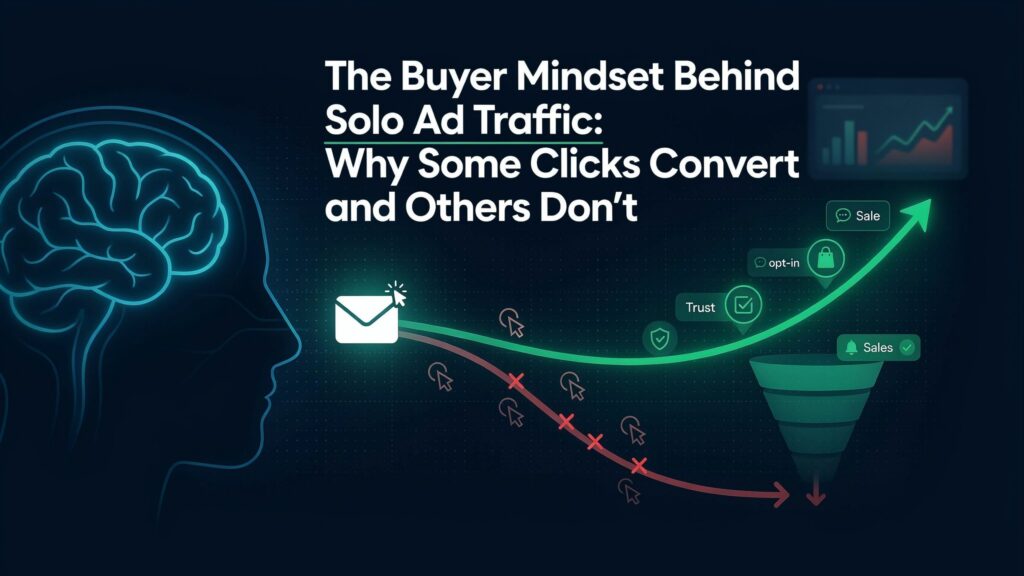
Not every click has the same value. Two people can receive the same email, click the same link, and land on the same page, yet one may subscribe or buy while the other immediately leaves.
The difference often comes down to solo ad traffic conversion and the mindset visitors have when they encounter your offer. Their level of awareness, trust, urgency, expectations, and perceived value can strongly influence what they do next.
Understanding buyer psychology allows marketers to create campaigns that do more than generate clicks. Instead, they can build a smoother path from initial curiosity to genuine interest, opt-in, and eventually purchase.
Here are seven important factors that influence how people respond to solo ad offers.
Table of Contents
Curiosity Gets the Click, but Intent Drives the Conversion
A click is often the result of curiosity.
Someone might see an interesting subject line, notice a promising benefit, or simply want to discover what is behind the link. But curiosity does not necessarily mean buying intent.
For example, consider this email message:
“Want to discover a new way to generate more leads? Click here to learn how.”
It may attract attention because the reader wants to know what the “new way” is.
However, once the visitor reaches the landing page, they may realize the offer is not relevant to their situation.
This creates an important distinction:
Curiosity creates clicks. Intent creates action.
Strong campaigns attempt to attract people who have a genuine connection to the problem being addressed.
If your offer helps affiliate marketers build email lists, your email should speak to people interested in lead generation—not simply anyone curious about making money online.
This distinction can have a major impact on solo ad traffic conversion because highly curious but poorly matched visitors may inflate click numbers without producing meaningful results.
The objective should be to attract qualified curiosity.
How Buyer Intent Influences Solo Ad Traffic Conversion
Buyer intent describes how ready someone is to take action.
Not every visitor arrives at the same stage of awareness.
Consider three prospects:
Prospect A — Low Intent
“I’ve heard about email marketing, but I’m just researching it.”
Prospect B — Moderate Intent
“I’m building an email list and looking for ways to get more subscribers.”
Prospect C — High Intent
“I need a reliable source of targeted leads and I’m ready to test a traffic solution.”
All three people might click an advertisement, but their likelihood of converting is different.
Understanding these differences can improve solo ad traffic conversion because your message can be designed around the audience’s current level of awareness.
For a low-intent audience, educational content may work better.
For a high-intent audience, a direct solution with a clear benefit may be more appropriate.
For example:
Educational angle:
“Learn the three biggest mistakes new marketers make when building an email list.”
High-intent angle:
“Get targeted email traffic to your landing page and start testing your next campaign.”
Matching the message to buyer intent creates a more natural customer journey.
Trust Is a Major Factor in Solo Ad Traffic Conversion
A visitor who has never heard of your brand has very little reason to trust you.
They may be asking:
- Who are you?
- Is this offer legitimate?
- Will I receive what was promised?
- Is my email address safe?
- Is there a hidden sales pitch?
- Can I believe these claims?
These questions can directly influence solo ad traffic conversion.
Trust can be strengthened through simple elements such as:
- Clear branding
- Professional design
- Transparent messaging
- Genuine testimonials
- Specific product information
- Clear expectations
- Privacy reassurance
- Realistic claims
Imagine two landing pages.
The first says:
“MAKE $10,000 THIS WEEK! CLICK NOW!”
The second says:
“Learn how experienced marketers use targeted email traffic to test and improve their lead-generation funnels.”
The second message may appear less sensational, but it can feel more credible because it sets a realistic expectation.
Trust does not require complicated psychology. Often, it comes from consistency between what the visitor was promised and what they actually receive.
People Respond to Benefits, Not Features
Another important part of buyer psychology is understanding the difference between features and benefits.
A feature explains what something has.
A benefit explains why the customer should care.
For example:
Feature:
“Includes 10 email templates.”
Benefit:
“Launch your next email campaign faster without writing every message from scratch.”
The second statement connects the feature to a desired outcome.
When writing your solo ad email and landing page, ask:
“What does this help the customer accomplish?”
Suppose you are promoting a marketing tool.
Instead of listing:
- Automated emails
- Analytics
- Segmentation
- Campaign templates
Explain what these features mean for the user:
- Spend less time managing campaigns
- Understand which messages perform best
- Send more relevant emails
- Launch campaigns faster
This approach can improve solo ad traffic conversion because the visitor can immediately understand the practical value of the offer.
People rarely buy features simply because they exist. They buy the result those features can help create.
Friction Can Stop an Interested Visitor
Sometimes a visitor wants your offer but still does not convert because the process feels difficult.
This is called friction.
Friction can come from:
- Long forms
- Slow pages
- Confusing navigation
- Too many steps
- Unclear instructions
- Unexpected costs
- Excessive pop-ups
- Poor mobile design
Imagine a visitor clicks your email expecting a free report.
They arrive at a page that asks for:
- Full name
- Phone number
- Address
- Company
- Job title
- Website
The visitor may wonder why so much information is necessary for a free report.
A simpler form asking only for an email address may remove that hesitation.
Every additional action creates another opportunity for the visitor to leave.
Review your funnel from the perspective of someone seeing your brand for the first time. Ask:
“What could make this process harder than it needs to be?”
Removing unnecessary friction can help turn existing interest into more completed actions.
How Expectations Shape Solo Ad Traffic Conversion
Visitors arrive with expectations created by the email they clicked.
If those expectations are not met, conversions can drop quickly.
For example, an email might say:
“Download the free 20-page guide to building an email list.”
But the landing page says:
“Join our premium marketing program.”
Even if the premium program is valuable, the visitor expected a free guide.
This mismatch creates disappointment and can negatively affect solo ad traffic conversion.
A better approach is to maintain continuity.
Email:
“Download the free email-list-building guide.”
Landing page:
“Get Your Free Email List Building Guide.”
Thank-you page:
“Your guide is ready. Here’s how to access it.”
Every stage reinforces the same expectation.
This creates a smoother psychological transition and reduces uncertainty.
Consistency matters because people are more likely to continue when each step feels like a logical continuation of the previous one.
The Follow-Up Determines What Happens After the Click
The customer journey does not end when someone subscribes.
In many campaigns, the initial click and opt-in are only the beginning of the relationship.
A strong follow-up sequence can:
- Deliver the promised resource.
- Establish credibility.
- Provide useful information.
- Address common objections.
- Demonstrate the value of your solution.
- Introduce a relevant offer.
For example:
Email 1:
Deliver the promised checklist.
Email 2:
Explain one common mistake related to the checklist.
Email 3:
Share a practical example or case study.
Email 4:
Introduce a relevant solution.
Email 5:
Answer common objections and provide a clear next step.
This approach gives subscribers time to understand your offer instead of immediately pushing for a purchase.
Your overall solo ad traffic conversion can improve when the follow-up experience matches the expectations created by the original advertisement.
A click may be the first interaction, but consistent communication is what can turn initial interest into long-term customer value.
Conclusion
Successful solo ad campaigns are not built around clicks alone. They depend on understanding why people click, what they expect when they arrive, and what makes them comfortable enough to take the next step.
Buyer intent, trust, perceived value, friction, expectation, and follow-up all influence solo ad traffic conversion.
The most effective strategy is to create consistency across the entire customer journey—from the first email subject line to the landing page and follow-up sequence.
Instead of asking only, “How can I get more clicks?”, ask a more valuable question:
“What does the person behind each click need to see, understand, and believe before taking action?”
That shift from traffic-focused thinking to buyer-focused thinking can help you build campaigns that generate not just visitors, but meaningful leads and customers.
Frequently Asked Questions
Why do some visitors convert while others leave?
Visitors have different levels of intent, awareness, trust, and interest. Their decision can also be affected by the landing page experience, offer relevance, and amount of friction.
What is buyer intent?
Buyer intent refers to how likely a person is to take a desired action, such as subscribing, requesting information, or making a purchase.
How can I build trust with new visitors?
Use clear messaging, professional branding, genuine proof, realistic claims, transparent expectations, and an easy-to-understand offer.
Should my landing page match my email?
Yes. The email and landing page should communicate a consistent promise. This reduces confusion and makes the transition between the two stages feel natural.
What is the difference between a feature and a benefit?
A feature describes what a product or service includes. A benefit explains how that feature helps the customer solve a problem or achieve a desired result.