Most people who try solo ads for the first time lose money. It isn’t because email traffic is dead or outdated. The real issue is that many beginners can’t tell the difference between a real human with a credit card and a clever bot script. This guide will show you how to spot fake clicks before you blow your entire marketing budget.
Table of Contents
The Reality Of Solo Ad Traffic Quality In Today’s Market
The solo ad industry is built on speed and volume. Vendors are under constant pressure to deliver hundreds of clicks within 24 hours. While many sellers maintain high quality email lists, others take shortcuts to increase their profit margins.
Honestly, it is a numbers game where the house usually wins if you don’t know the rules. You need to understand that not every click is equal. Some clicks are from people who are genuinely looking for a business opportunity, while others are just digital noise.
For example, if you buy 200 clicks for $30 and receive 100% Tier 1 traffic from the USA, you are likely looking at bot traffic because the wholesale cost of acquiring those real leads usually exceeds $0.40 per click.
I learned this the hard way after spending hundreds on “bargain” traffic that never opened a single follow-up email. You have to be willing to pay a fair price for real humans. Real people have real costs associated with reaching them.
Why Bot Traffic Exists And How It Mimics Human Behavior
Bots have become incredibly sophisticated over the last few years. They don’t just click a link and leave anymore. Modern scripts can scroll down your page, hover over your opt-in button, and even fill out your form with fake data.
Vendors use these tools to pad their click counts when their lists are tired. It’s a way for them to fulfill orders without having to send more emails to their actual subscribers. This keeps their “click through rate” looking healthy on the surface.
For example, a sophisticated bot might stay on your squeeze page for exactly 12 seconds to mimic the reading time of a human before it triggers a fake form submission. This makes your Solo Ad Hub education center stats look amazing while your bank account stays empty.
That is why looking at opt-in rates alone is a dangerous mistake. You need to look at what happens after the click. Real humans have erratic behavior, while bots often follow a predictable pattern in your server logs.
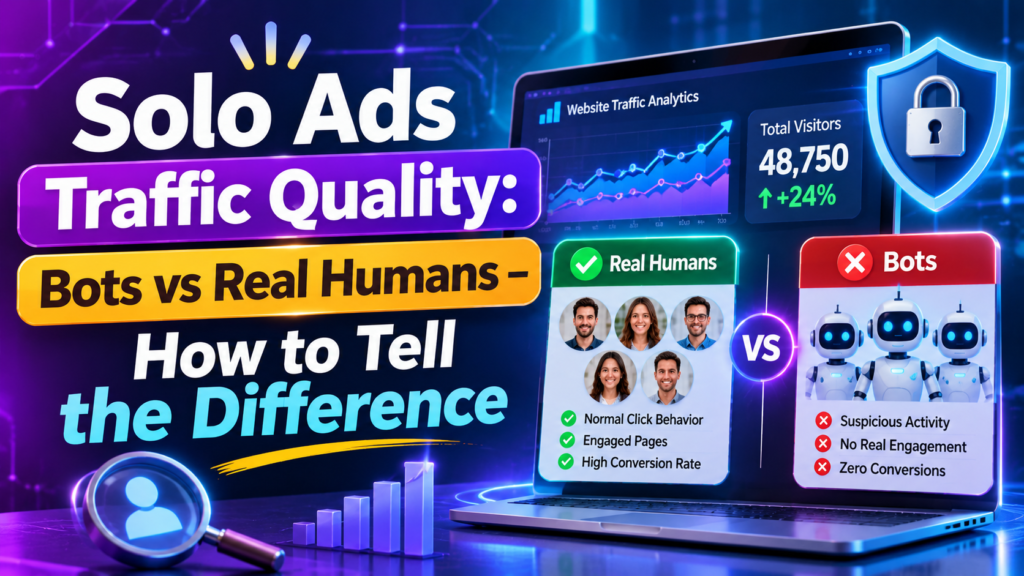
Comparison Table: Real Human Behavior vs Bot Traffic Patterns
| Metric | Real Human Traffic | Bot Traffic Patterns |
|---|---|---|
| Time On Page | Variable (5 seconds to 2 minutes) | Uniform (Usually fixed intervals) |
| Opt-in Quality | Uses primary email addresses | Uses gibberish or disposable emails |
| Email Opens | Consistent over 7-day sequence | Zero or “ghost” automated opens |
| IP Addresses | Residential and mobile IPs | Data center or proxy IPs |
Most beginners ignore these details. For example, if you see 50 clicks come in within a single minute and all of them are using the same version of an outdated Chrome browser, you are definitely being sent bot traffic. Real traffic is messy and diverse.
Red Flags That Your Solo Ad Traffic Is Mostly Bots
The first sign of trouble is usually a “too good to be true” conversion rate. If you are seeing an 80% opt-in rate on a cold traffic solo ad, you should be very skeptical. Even the best copywriters rarely see those numbers with real people.
Another red flag is the “instant opt-in.” This happens when a click is recorded and a form is submitted in less than a second. No human can read a headline and enter an email address that fast.
For example, if you receive 100 leads and every single one of them has a name like “Asdf Ghjk” or uses a domain like @sharklasers.com, you have likely been hit by a bot farm. These leads will never buy anything and will only hurt your email deliverability.
Check your autoresponder for “bounces” immediately after the campaign ends. High quality solo ad traffic quality should have a bounce rate below 5%. If 20 out of 100 emails bounce instantly, the vendor is likely using a scraped or fake list.
The Technical Tools You Need To Filter Traffic
You cannot rely on the vendor’s stats or your autoresponder’s basic dashboard. You need a dedicated tracking tool that specializes in click fraud detection. These tools act as a filter between the vendor’s email and your squeeze page.
They check the IP address, the device type, and the browser fingerprint of every visitor. If the tool detects a known bot or a proxy server, it can block the click or flag it for a refund. This is the only way to protect your solo ad traffic quality.
For example, using a tool like ClickMagick traffic tracking tool allows you to see if 30% of your traffic is coming from automated “headless” browsers that don’t actually render your website. This data gives you the leverage to ask for a refund or a traffic replacement.
Think about it this way: you wouldn’t buy a house without an inspection. Don’t buy thousands of clicks without a tracker. It’s the most profitable investment you can make in your business.
Step By Step Checklist For Vetting A New Solo Ad Vendor
Before you send a single dollar to a new vendor, you need to do your homework. Don’t just look at the screenshots they post on social media. Anyone can fake a screenshot with a few clicks of a mouse.
- Ask for their current Tier 1 percentage.
- Check for recent reviews from the last 14 days.
- Ask if they use any click rotators or ad flies.
- Inquire about the source of their new subscribers.
- Start with a small test order.
Let’s be real, a vendor who gets defensive when you ask about traffic quality is a vendor you should avoid. A professional seller will be happy to explain how they filter their list and maintain their engagement rates.
For example, a legitimate vendor will tell you that they add 500 new subscribers a day through Facebook ads or YouTube traffic to keep their list fresh. If they say “it’s a secret,” run the other way as fast as you can.
Understanding The Role Of Top Tier Traffic In Quality
In the world of solo ads, “Top Tier” or T1 usually refers to five specific countries: the USA, UK, Canada, Australia, and New Zealand. These are the countries with the highest purchasing power. Most vendors charge a premium for 100% T1 traffic.
If you are promoting a high-ticket affiliate offer, you need T1 traffic. Traffic from other countries might be cheaper, but the conversion rate on the backend is usually much lower. You get what you pay for when it comes to geographic targeting.
For example, you might pay $40 for 100 clicks from a “mixed” global list, but if 60% of those clicks are from countries that can’t even use your payment processor, you have wasted your money. It is better to pay $70 for 100 clicks from the USA where everyone has a credit card.
Quality over quantity is the golden rule. It is better to have 50 real humans looking at your offer than 5,000 bots clicking your links. Your goal is sales, not just big numbers in your tracker.
How To Read Your Tracking Data Like A Pro
Once your campaign starts, you need to watch the data in real-time. Look for “clumping.” This is when you get a massive burst of clicks in a few minutes followed by hours of silence. Real email traffic usually trickles in as people open their mail throughout the day.
Pay attention to the “Unique Clicks” versus “Total Clicks” ratio. If a vendor sends you 500 total clicks but only 200 are unique, they are likely over-mailing their list. This results in poor solo ad traffic quality because those people are seeing too many offers.
For example, a healthy campaign might show 100 unique clicks and 110 total clicks, meaning only 10 people clicked the link twice. If you see 100 unique clicks and 300 total clicks, the vendor’s list is likely ignoring the emails or the vendor is using a forced-click script.
One thing I’ve noticed is that the best traffic often has a lower initial opt-in rate but a much higher long-term value. Don’t panic if your opt-in rate is 25% instead of 40%. If those 25 people are real, they will actually buy things.
Common Mistakes When Judging Solo Ad Traffic Quality
The biggest mistake beginners make is judging a vendor based on a single 100-click test. While a test can show you red flags, it isn’t always enough data to judge the true quality of a list. You need to look for consistency over time.
Another mistake is failing to set up a proper “bridge page.” If you send traffic directly to an affiliate offer, you have no way of knowing if the traffic was real or if the affiliate page just failed to convert. You must capture the lead yourself first.
For example, if you spend $50 on a test and get zero sales, you might think the traffic was bad. However, if you didn’t have a bridge page, you missed the fact that 40 real people opted in and are now on your email list for free future marketing.
Here’s what most beginners miss: the profit in solo ads is in the follow-up, not the first click. Even high quality human traffic rarely buys on the first exposure. You need to judge quality by how many people open your second, third, and fourth emails.
Best Practices For Ensuring Long Term Success
Success with solo ads requires a systematic approach. You should keep a spreadsheet of every vendor you use, the price you paid, the opt-in rate, and the “Value Per Lead” after 30 days. This allows you to identify the winners and cut the losers quickly.
Always communicate your expectations to the vendor before the mailing starts. Tell them you are using a tracker and that you are looking for high T1 percentages. Most vendors will give you their best traffic if they know you are monitoring the data closely.
For example, telling a vendor “I need 90% USA traffic and I will be checking for proxy IPs” can often discourage a shady seller from sending you bot traffic in the first place. It shows you are an experienced buyer who knows the industry.
That said, remember to be fair. Even the best lists have “off” days. If a vendor has been consistent for months but gives you one bad run, talk to them about it before leaving a negative review. Often, they will make it right with a fresh mailing.
Conclusion
Solo ads are one of the fastest ways to grow an email list, but they are not without risks. Understanding solo ad traffic quality is the difference between building a sustainable business and throwing money into a digital void. You must move past the surface-level metrics like click counts and opt-in rates to see the real story behind the data.
Real humans behave in unpredictable ways, while bots are often too perfect. By using a dedicated tracker, vetting your vendors, and focusing on Top Tier traffic, you can filter out the noise and find the leads that actually convert into customers. Never stop testing and never assume a vendor is good just because their price is low.
For example, a marketer who spends $500 on 10 different 100-click tests will always be more successful than one who spends $500 on a single 1,000-click order from an unverified source. Take your time, watch your numbers, and protect your investment at every step. Your email list is your most valuable asset, so make sure the people on it are actually real.
Frequently Asked Questions
How Many Clicks Should I Buy For My First Test?
You should always start with a 100-click test when trying a new vendor. This is enough data to see your opt-in rate and check for initial bot patterns without risking a large budget. If the quality is high, you can scale up gradually in the next order.
For example, if you buy 100 clicks and get 35 leads, you can see if those 35 people open your first automated email. If 0% open the email, you know the traffic was likely fake and you only lost about $50 instead of $500.
What Opt-in Rate Should I Expect From Solo Ad Traffic?
A healthy opt-in rate for solo ads usually falls between 30% and 50%. This depends heavily on your headline and the relevance of your offer to the vendor’s list. Anything significantly higher than 60% should be investigated for potential bot activity or incentivized clicks.
For example, if you send 200 clicks to a simple squeeze page and get 140 leads, that is a 70% conversion rate. Unless your offer is incredibly unique, you should check your tracker for “duplicate IP addresses” or “proxy traffic” immediately.
How Do I Know If The Traffic I Received Was Real?
The best way to verify traffic is through engagement after the opt-in. Real humans will click links in your welcome email, reply to your questions, and occasionally unsubscribe if they aren’t interested. Bots will do none of these things over a long period.
For example, if you have 100 new leads and you send them a survey, getting even 2 or 3 detailed responses is a great sign that the traffic is human. Bots can’t answer open-ended questions about their business goals or challenges.
Can I Use Solo Ads To Promote Affiliate Offers Directly?
It is generally a bad idea to send solo ad traffic directly to an affiliate link. You lose the ability to track the leads and you can’t follow up with the people who didn’t buy immediately. Always use a squeeze page to build your own list first.
For example, sending 500 clicks to a $27 affiliate offer might get you 2 sales, which doesn’t cover your $250 traffic cost. If you send them to a squeeze page first, you might get 200 leads that you can mail every day for the next year.
What’s The Difference Between Top Tier And Second Tier Traffic?
Top Tier traffic comes from wealthy English-speaking countries like the USA and UK. Second Tier traffic comes from countries like the Philippines or India where the cost of living is lower. Second Tier is cheaper, but the leads often have less money to spend on digital products.
For example, 1,000 clicks from a Second Tier list might cost you only $150, but you might make zero sales. Conversely, 300 clicks from a Top Tier list might cost $210 but result in 5 sales because the audience has more disposable income.
What Tracking Tools Work Best For Solo Ad Campaigns?
Professional marketers use tools like ClickMagick because they have built-in “Click Analysis” features. These tools compare every click against a massive database of known bot IPs and data centers. They provide a “Quality Score” for every batch of traffic you buy.
For example, if your tracker shows a “Quality Score” of 15 out of 100, it means the traffic is almost entirely from automated scripts. This data is your primary defense against getting scammed by low-quality vendors who use “click injection” techniques.