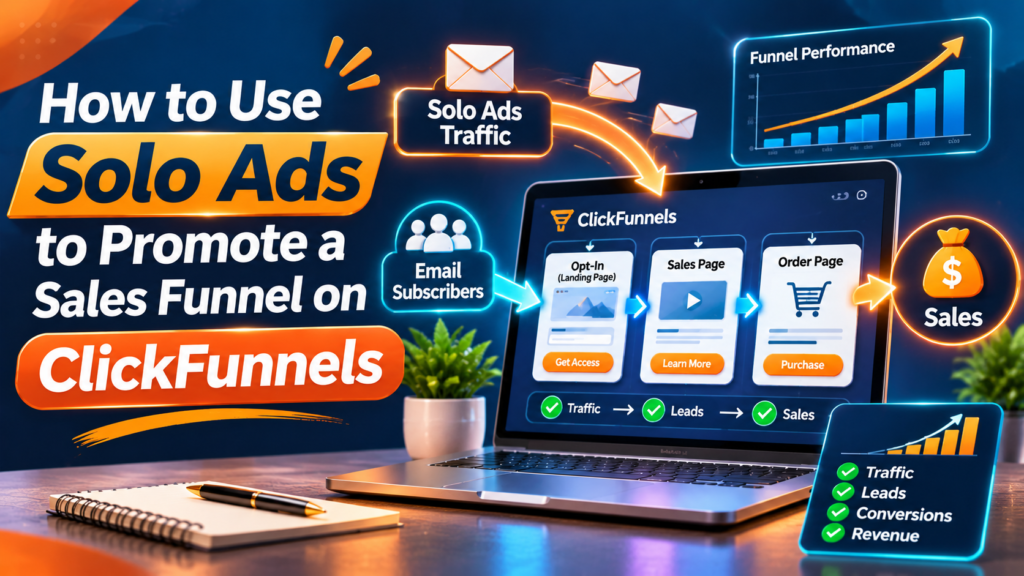
Most marketers think they can just throw traffic at a sales page and watch the money roll in. If you have tried this, you already know it usually ends with a drained bank account and a lot of frustration. The reality is that solo ads are a unique beast that require a specific setup to actually turn a profit.
You need a system that captures attention instantly and moves people through a process. Using solo ads to promote a sales funnel on ClickFunnels is one of the fastest ways to build an audience. But if you don’t do it correctly, you are just gambling with your marketing budget.
I have seen countless beginners make the same mistakes over and over. They buy the wrong traffic or send it to a page that takes five seconds to load. Here is the step by step guide on how to actually make this combination work for your business.
Table of Contents
Why Solo Ads and ClickFunnels Are a Powerful Combination
Solo ads provide immediate traffic on demand. You don’t have to wait for SEO rankings or hope the Facebook algorithm likes your ad. You pay a vendor, and they send an email to their subscribers with your link in it.
ClickFunnels is designed specifically to handle this type of fast, direct response traffic. It allows you to build a squeeze page that loads quickly and looks professional without needing a developer. When you combine the speed of solo ads with the conversion focus of ClickFunnels, you get a lead generation machine.
For example, a standard blog post might take months to generate 100 visitors, whereas a solo ad can send 100 targeted clicks to your ClickFunnels opt-in page in less than four hours. This speed allows you to test your offers and headlines in real time.
One thing I have noticed is that solo ad traffic is very impatient. These people are clicking a link inside an email. They want to see what you promised and they want to see it fast. ClickFunnels makes it easy to give them exactly that.
Building Your Squeeze Page for Maximum Conversions
Your squeeze page is the most important part of your funnel when using solo ads. This is the page where you ask for an email address in exchange for a lead magnet. If this page fails, the rest of your funnel doesn’t matter.
The headline needs to be big, bold, and direct. It should focus on a specific result or a solution to a problem. Don’t try to be clever or poetic. Just tell them what they are going to get.
For example, if you are in the weight loss niche, a headline like “Lose 5 Pounds in 10 Days Without Giving Up Pizza” will perform much better than “Start Your Wellness Journey Today.” One offers a specific result while the other is just vague marketing fluff.
Keep the page clean. Remove any navigation menus, social media icons, or external links. The only thing the visitor should be able to do is enter their email or leave the page. This lack of distraction is why ClickFunnels is so effective for this strategy.
Essential Squeeze Page Checklist
- Strong, benefit driven headline
- Simple opt-in form with only an email field
- High contrast call to action button
- Fast loading images and no heavy videos
- Mobile optimized layout
For example, removing the name field from your opt-in form can often increase your conversion rate by 5% to 8% because it reduces the effort required from the user. Most solo ad buyers only care about the email address anyway.
The Bridge Page Strategy You Should Never Skip
Many beginners send traffic from the squeeze page directly to an affiliate offer. This is a massive mistake. You need a bridge page to introduce yourself and pre-sell the offer.
A bridge page is a simple page between the opt-in and the final sales page. It usually contains a short video or a few paragraphs of text. This helps build trust with the person who just joined your list.
For example, a 60-second video on your bridge page where you explain how the product helped you can increase your affiliate sales by 20% compared to sending them to a cold sales page. It makes the transition feel natural rather than aggressive.
The bridge page also gives you a chance to set expectations. Tell them to check their inbox for the free gift you promised. This ensures they actually look for your first email, which improves your sender reputation and long term deliverability.
Tracking Your Results Like a Professional
If you aren’t tracking your clicks, you are flying blind. You need to know which vendors are sending real human traffic and which ones are sending bots or low quality clicks. ClickFunnels has basic stats, but it is not enough for solo ads.
You should use a dedicated tracking tool to monitor every click that enters your funnel. This allows you to see the location of the traffic, the device type, and whether the person actually opted in. Most professionals use ClickMagick tracking software to manage their solo ad campaigns.
For example, you might buy 500 clicks from a vendor and realize that 200 of them are coming from countries that don’t even speak the language of your offer. A tracker will show you this immediately, so you can ask the vendor for a refund or a make-good on the traffic.
Without tracking, you might think your funnel is the problem when it is actually the traffic source. Always look at your data before making changes to your ClickFunnels pages. Data doesn’t lie, but your gut feeling often does.
| Metric to Track | Why It Matters | Target Goal |
|---|---|---|
| Opt-in Rate | Shows if your squeeze page headline matches the traffic. | 35% – 50% |
| Tier 1 Percentage | Ensures traffic is from high-buying countries like USA/UK. | 85% – 100% |
| Cost Per Lead (CPL) | The actual price you pay for every new subscriber. | Under $1.50 |
Keep a close eye on these numbers during your first few runs. For example, if your cost per lead is $3.50, you will likely struggle to turn a profit on a standard affiliate offer. You need to adjust your headline or find a more affordable vendor who still provides quality traffic.
Finding High Quality Solo Ad Vendors
The biggest risk in this business is buying bad traffic. There are many vendors who sell fake clicks generated by scripts. You need to find people who have established lists of real people who actually open their emails.
Start by looking at marketplaces that have a rating system. You want to see recent reviews from people who actually made sales from the traffic. Don’t just look at the price per click, because cheap traffic is often the most expensive in the long run.
For example, buying 100 clicks from a top rated seller at $0.70 each for a total of $70 is a much smarter move than buying 300 clicks for $60 from an unverified source. Quality always beats quantity when it comes to email lists.
I always recommend starting with a platform like the Udimi solo ad marketplace because they filter for bot traffic automatically. This gives you a layer of protection that you don’t get when buying directly through PayPal on a random website.
How to Test Your Funnel Without Breaking the Bank
Never start with a 1,000-click order. It is the fastest way to lose your budget if your funnel has a technical glitch or your headline doesn’t resonate. Always start with a small test of 100 or 200 clicks.
This small batch of traffic will give you enough data to see if people are actually opting in. If you get zero opt-ins from 100 clicks, something is wrong with your ClickFunnels page. It might be a broken button or a slow load time.
For example, a simple 100-click test costing $50 can tell you if your funnel is converting at 40% or 10%. If it is converting at 10%, you can stop the campaign, fix the page, and save hundreds of dollars you would have otherwise wasted.
Think of your first few hundred clicks as an investment in data rather than an investment in sales. If you make sales, that is a great bonus. But the primary goal is to verify that your funnel is working properly.
Red Flags to Watch Out For
When you are buying solo ads, you need to be cautious. If a vendor makes promises that sound too good to be true, they probably are. Real vendors will never guarantee that you will make a specific amount of money.
Watch out for vendors who refuse to provide tracking or who insist on being paid through non-refundable methods like Bitcoin or Friends and Family on PayPal. Professional sellers have no problem using secure platforms or providing detailed stats.
For example, if a vendor claims a 90% opt-in rate for their traffic, you should be very skeptical. Most high quality solo ad traffic converts at 30% to 55% on a standard squeeze page. Anything significantly higher than that is often a sign of incentivized or bot traffic.
Optimizing Your Email Follow Up Sequence
The money in solo ads is not usually made on the first click. It is made in the follow-up. You need to have an automated email sequence set up in your autoresponder that triggers the moment someone joins your ClickFunnels list.
Your first email should deliver the lead magnet immediately. The following emails should provide value, share stories, and continue to recommend your offer. Most sales happen after the fifth or sixth email a subscriber receives.
For example, a subscriber who didn’t buy on Monday might decide to buy on Thursday after seeing a testimonial you sent in your third email. If you don’t have that follow-up sequence ready, you are leaving 80% of your potential revenue on the table.
Consistency is the secret here. You should be emailing your list at least once every day or two. If you wait a week to email them, they will forget who you are and mark your messages as spam.
Common ClickFunnels Mistakes to Avoid
One of the most common issues I see is “Funnel Friction.” This happens when you ask for too much information or make the process confusing. Solo ad traffic is cold traffic, and they don’t know you yet.
Don’t use complex designs with lots of bells and whistles. A simple white background with black text and a clear call to action usually converts best for solo ads. You want the visitor to make a decision in less than three seconds.
For example, adding a video that auto-plays with sound can actually lower your conversion rate because it startles people who are browsing on their phones. It is better to have a play button or a static image that leads to a video on the next page.
Another mistake is not checking your funnel on a mobile device. Over 70% of solo ad traffic now comes from mobile phones. If your ClickFunnels page looks weird or the button is too small to click on an iPhone, you are throwing money away.
Conclusion
Using solo ads to promote a sales funnel on ClickFunnels is a proven strategy for building an email list and generating affiliate commissions. However, success requires more than just a credit card and a dream. You must focus on the technical details like page speed, headline clarity, and precise tracking to ensure your traffic is actually working for you.
The biggest mistake you can make is trying to scale too fast before you have real data. Always treat your first few campaigns as a learning experience. Once you find a vendor that provides high tier traffic and a headline that captures leads at a good rate, you can start to increase your budget with confidence.
For example, if you spend $300 on a test and generate 120 leads and two sales, you now have a baseline to work from. You can then aim to improve your bridge page or email follow-up to turn that into four sales on your next run. If you want to learn more about picking the best traffic sources, check out the resources at the Solo Ad Hub resource library for more detailed guides.
Frequently Asked Questions
How Many Clicks Should I Buy for My First Test?
You should generally start with 100 to 200 clicks to see how your funnel performs. This is a large enough sample size to give you a reliable opt-in rate without risking too much capital. For example, a 100-click test at $0.50 per click will cost you $50 and provide enough data to tell if your headline is resonating with that specific audience. If the results are good, you can then scale up to 500 clicks with the same vendor.
What Opt-In Rate Should I Expect From Solo Ad Traffic?
A healthy opt-in rate for solo ad traffic on a ClickFunnels squeeze page is typically between 30% and 50%. If your rate is lower than 20%, you probably need to change your headline or simplify your page design. For example, if you send 200 clicks to a page and only get 20 leads, that is a 10% conversion rate which indicates a major disconnect between the email swipe and your landing page. Always aim for at least 35% to ensure your lead costs stay manageable.
Can I Promote Affiliate Offers Directly With Solo Ads?
You can, but it is rarely profitable in the long run because you aren’t building an asset. When you send traffic directly to an affiliate link, the vendor gets the lead and you only get a commission if they buy immediately. For example, if you spend $100 on traffic to an affiliate link and make one $40 sale, you have lost $60 and have no way to contact the other 99% of people who didn’t buy. Always use a ClickFunnels squeeze page so you can follow up with your leads via email.
How Do I Know if the Solo Ad Traffic I Received Was Real?
The best way to verify traffic is by using a third-party tracking tool that identifies bot patterns and click farms. You should also look at the engagement of the leads that do opt in to your list. For example, if you get 50 new subscribers but zero people open your first automated email, there is a high probability that the traffic was fake or incentivized. Legitimate Tier 1 traffic should have an initial email open rate of at least 15% to 25%.
What Is the Difference Between Top-Tier and Second-Tier Traffic?
Top-tier traffic comes from countries with the highest purchasing power, such as the USA, UK, Canada, Australia, and New Zealand. Second-tier traffic includes countries where English is common but the economy might be weaker. For example, a solo ad vendor might offer a package with 100% Tier 1 traffic for $0.80 per click or a “Global” package for $0.40 per click. Most marketers find that paying more for Tier 1 results in much higher sales conversion rates on ClickFunnels.
How Long Does It Usually Take for a Solo Ad To Be Delivered?
Most solo ad vendors will begin sending traffic within 24 to 48 hours of your order being placed. The entire delivery usually finishes within 72 hours depending on the size of the order. For example, if you order 1,000 clicks, the vendor might spread that over three days to ensure their email list doesn’t get burnt out. If a vendor hasn’t started sending traffic after three days, you should reach out to them for an update on your campaign status.
How Many Clicks Should I Buy for My First Test?
You should generally start with 100 to 200 clicks to see how your funnel performs. This is a large enough sample size to give you a reliable opt-in rate without risking too much capital. For example, a 100-click test at $0.50 per click will cost you $50 and provide enough data to tell if your headline is resonating with that specific audience. If the results are good, you can then scale up to 500 clicks with the same vendor.
What Opt-In Rate Should I Expect From Solo Ad Traffic?
A healthy opt-in rate for solo ad traffic on a ClickFunnels squeeze page is typically between 30% and 50%. If your rate is lower than 20%, you probably need to change your headline or simplify your page design. For example, if you send 200 clicks to a page and only get 20 leads, that is a 10% conversion rate which indicates a major disconnect between the email swipe and your landing page. Always aim for at least 35% to ensure your lead costs stay manageable.
Can I Promote Affiliate Offers Directly With Solo Ads?
Lorem ipsum dolor sit amet, consectetur adipiscing elit. Ut elit tellus, luctus nec ullamcorper mattis, pulvinar dapibus leo.
You can, but it is rarely profitable in the long run because you aren’t building an asset. When you send traffic directly to an affiliate link, the vendor gets the lead and you only get a commission if they buy immediately. For example, if you spend $100 on traffic to an affiliate link and make one $40 sale, you have lost $60 and have no way to contact the other 99% of people who didn’t buy. Always use a ClickFunnels squeeze page so you can follow up with your leads via email.
How Do I Know if the Solo Ad Traffic I Received Was Real?
The best way to verify traffic is by using a third-party tracking tool that identifies bot patterns and click farms. You should also look at the engagement of the leads that do opt in to your list. For example, if you get 50 new subscribers but zero people open your first automated email, there is a high probability that the traffic was fake or incentivized. Legitimate Tier 1 traffic should have an initial email open rate of at least 15% to 25%.
What Is the Difference Between Top-Tier and Second-Tier Traffic?
Top-tier traffic comes from countries with the highest purchasing power, such as the USA, UK, Canada, Australia, and New Zealand. Second-tier traffic includes countries where English is common but the economy might be weaker. For example, a solo ad vendor might offer a package with 100% Tier 1 traffic for $0.80 per click or a “Global” package for $0.40 per click. Most marketers find that paying more for Tier 1 results in much higher sales conversion rates on ClickFunnels.