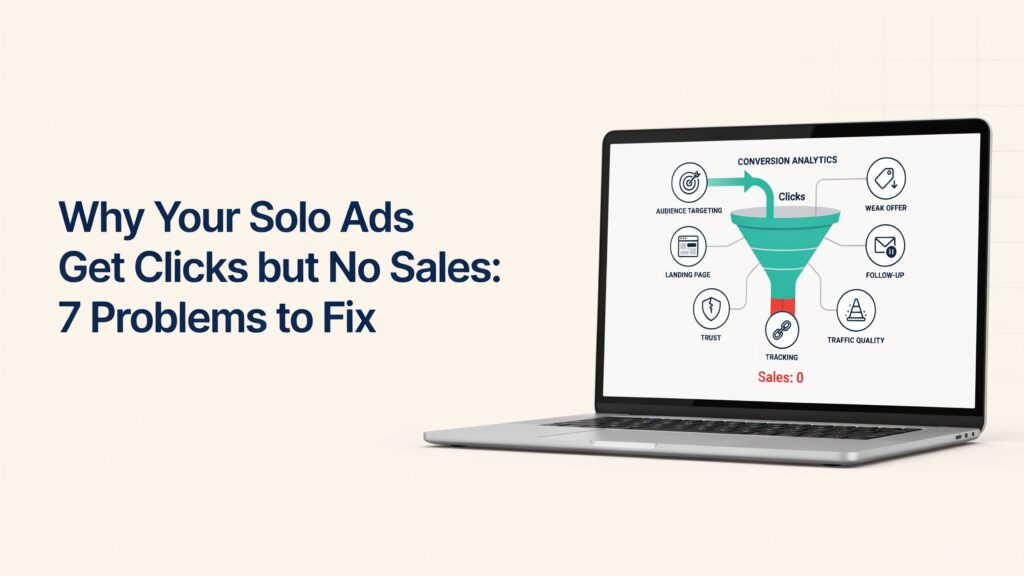
Getting traffic is exciting, but traffic alone does not guarantee revenue. If your campaign generates plenty of visitors but very few purchases, you may be dealing with solo ads clicks but no sales.
This problem is more common than many marketers realize. A campaign can have an attractive email, a strong click-through rate, and hundreds of visitors while producing almost no revenue. The issue is often not the traffic itself. Instead, the problem can be your targeting, offer, landing page, follow-up sequence, or conversion strategy.
The good news is that these problems can usually be identified and fixed. In this guide, we will break down seven common reasons behind poor solo ad conversions and explain what you can do to improve your results.
Table of Contents
Your Traffic Does Not Match Your Target Audience
One of the biggest reasons for solo ads clicks but no sales is poor audience alignment.
A person can click your advertisement because the headline sounds interesting without actually being interested in buying what you offer. Clicks indicate curiosity or initial interest, but they do not automatically indicate purchase intent.
For example, imagine you sell a premium email marketing course designed for established online businesses. If your solo ad reaches a list primarily interested in making money quickly with little marketing experience, you might receive plenty of clicks but very few customers.
Before buying traffic, define your ideal customer carefully. Consider:
- What problem are they trying to solve?
- What type of product do they normally purchase?
- What level of experience do they have?
- What price range are they comfortable with?
- What topics does the audience regularly engage with?
You should also communicate these requirements to your solo ads vendor. A good vendor should be able to explain the type of audience receiving your promotion.
Example: Instead of targeting a broad “online business” audience, target subscribers interested specifically in affiliate marketing, lead generation, or email marketing if those topics closely match your offer.
Better audience alignment can reduce wasted clicks and improve the percentage of visitors who take meaningful action.
Your Solo Ads Clicks but No Sales Problem Starts With the Offer
Sometimes the traffic is not the problem. Your offer simply does not give visitors enough reason to buy.
The solo ads clicks but no sales issue can occur when the product’s perceived value is lower than the price, the benefits are unclear, or the offer does not solve an urgent problem.
Ask yourself one important question:
Why should someone buy this product today instead of leaving the page?
A strong offer should communicate a clear transformation. Instead of focusing only on features, explain the result customers can expect.
For example:
Weak:
“Get access to 25 email marketing lessons.”
Stronger:
“Learn how to build an email funnel that turns new subscribers into repeat customers.”
The second statement focuses on an outcome rather than simply describing the product.
You can also strengthen an offer with relevant bonuses, guarantees, limited-time incentives, demonstrations, case studies, or clear proof of value.
However, avoid adding unnecessary bonuses just to make the offer look bigger. Every element should support the buyer’s primary problem.
If visitors understand exactly what they receive, why it matters, and how it can help them, your conversion potential becomes much stronger.
Your Solo Ads Clicks but No Sales Issue Could Be Your Landing Page
After someone clicks your advertisement, the landing page takes over. If the page is confusing, slow, poorly structured, or disconnected from the email, visitors may leave before purchasing.
This is another major cause of solo ads clicks but no sales.
Your landing page should continue the message that convinced the visitor to click.
For example, if your email promises:
“Discover 5 ways to generate more qualified leads without increasing your ad budget.”
The landing page should immediately reinforce that promise. If the visitor instead sees a generic headline such as “Welcome to Our Website,” the connection is broken.
A strong landing page should generally include:
- A clear headline
- A specific value proposition
- Concise supporting copy
- Relevant benefits
- Social proof or testimonials
- A noticeable call-to-action
- A simple conversion process
- Mobile-friendly design
Avoid placing too many unrelated offers, navigation links, pop-ups, and distractions on the page.
You should also test your page on mobile devices. A significant portion of paid traffic can come from mobile users, and a difficult mobile experience can quickly destroy conversions.
Simple test: Ask someone unfamiliar with your business to look at your landing page for 10 seconds. Then ask them what the page is offering and what action they should take. If they cannot answer easily, your page needs improvement.
Your Follow-Up Strategy Stops Too Early
Not every visitor will purchase during their first visit. That does not mean the campaign failed.
Many marketers make the mistake of treating the initial click as the entire customer journey. In reality, the first visit may only be the beginning.
A visitor might need more information, additional proof, answers to objections, or simply more time before making a decision. This is why follow-up matters.
If your solo ads clicks but no sales results are disappointing, review what happens after visitors subscribe.
A basic follow-up sequence might look like this:
Email 1: Deliver the promised lead magnet and introduce the core problem.
Email 2: Explain a common mistake related to that problem.
Email 3: Provide a useful strategy or quick win.
Email 4: Share a case study, testimonial, or example.
Email 5: Present your paid solution and explain who it is best suited for.
Email 6: Address common objections.
Email 7: Create a final reason to take action.
The exact sequence will depend on your product and audience, but the principle remains the same: don’t expect every visitor to become a customer immediately.
A strong follow-up system allows you to continue building trust after the initial traffic arrives.
Your Page Does Not Build Enough Trust
People rarely purchase from a business they do not trust.
This is especially important when visitors arrive from an unfamiliar source. They may not know your company, your product, or whether your claims are legitimate.
If you are experiencing solo ads clicks but no sales, examine the trust signals on your website.
Consider adding:
- Customer testimonials
- Case studies
- Demonstrations
- Transparent pricing
- Clear contact information
- Secure checkout information
- Refund or guarantee details where appropriate
- Professional branding
- Evidence supporting important claims
Trust should also be built through consistency. The name, promise, tone, and expectations created by your advertisement should match what visitors see on the landing page.
For example, if an email promises a simple beginner-friendly solution but your landing page immediately uses complicated technical language, visitors may question whether the product is right for them.
Avoid fake scarcity, exaggerated income claims, misleading testimonials, or unrealistic promises. These tactics may generate temporary attention but can damage long-term credibility.
Your objective is not simply to persuade someone to buy. It is to make the purchase decision feel reasonable, safe, and valuable.
Your Solo Ads Clicks but No Sales Results Are Hiding a Tracking Problem
Sometimes marketers believe they have a conversion problem when they actually have a measurement problem.
If your solo ads clicks but no sales numbers seem unusual, verify that your tracking system is working correctly.
At minimum, you should know:
- How many clicks were delivered
- How many unique visitors arrived
- How many people opted in
- How many visitors reached the sales page
- How many purchases occurred
- Your cost per lead
- Your cost per customer
- Your overall return on investment
Suppose you purchased 500 clicks and your system reports 0 sales. Before concluding that the campaign failed, verify your checkout and analytics tracking.
You may discover that purchases are occurring but are not being attributed correctly.
Use tracking links or UTM parameters to identify where visitors came from. Keep separate tracking for different vendors, campaigns, offers, and landing pages.
For example:
Vendor A → Campaign 1 → Landing Page A
Vendor B → Campaign 2 → Landing Page B
This structure makes performance comparisons much easier.
Accurate tracking helps you distinguish between a genuinely weak campaign and a technical reporting issue.
You Are Optimizing Clicks Instead of Customers
A high click-through rate looks impressive, but clicks are only one stage of the customer journey.
One of the most important lessons when dealing with solo ads clicks but no sales is that traffic volume should not be your only performance target.
Consider two campaigns:
Campaign A
- 1,000 clicks
- 100 leads
- 2 sales
- $100 revenue
Campaign B
- 500 clicks
- 80 leads
- 10 sales
- $500 revenue
Campaign A generated twice as many clicks, but Campaign B produced five times the revenue.
This is why you should evaluate the entire funnel instead of focusing on traffic volume alone.
Look at metrics such as:
Click → Opt-in → Sales → Revenue → ROI
If many people click but few opt in, investigate your landing page.
If many people opt in but few purchase, investigate your offer and follow-up.
If customers purchase but revenue remains low, examine pricing, upsells, retention, and customer lifetime value.
The goal is not to collect the largest number of visitors. The goal is to acquire the right visitors and turn a reasonable percentage of them into profitable customers.
Conclusion
Solo ads clicks but no sales does not necessarily mean solo ads are ineffective. It usually means something between the click and the purchase needs attention.
Start by checking your audience targeting. Then evaluate your offer, landing page, follow-up sequence, trust signals, tracking, and overall funnel.
Do not make changes to everything at once. Identify where visitors are dropping out and fix that stage first.
With accurate tracking and systematic testing, you can turn more of your paid traffic into leads, customers, and measurable revenue.
The most successful solo ad campaigns are not built around clicks alone. They are built around the complete customer journey—from the first email to the final purchase.
Frequently Asked Questions
Why do paid traffic campaigns get clicks but no purchases?
Clicks can happen because an advertisement creates curiosity, while purchasing requires stronger intent, trust, and perceived value. The problem may be targeting, the offer, the landing page, or the follow-up process.
How can I improve my solo ad conversion rate?
Start by matching the audience to your offer, creating a focused landing page, strengthening your value proposition, adding trust signals, and testing your follow-up emails.
How many clicks should I test before judging a campaign?
There is no universal number because results depend on the offer, audience, price, funnel, and conversion rate. Collect enough data to identify a meaningful pattern rather than making decisions from a handful of visitors.
Should I change my landing page or advertisement first?
Look at your funnel data. If people click but immediately leave without engaging, investigate the landing page and message match. If the traffic itself is poorly aligned, review your audience targeting and advertisement.
What metrics should I track for solo ad campaigns?
Track clicks, unique visitors, opt-ins, conversion rate, sales, cost per lead, cost per customer, revenue, and ROI. These metrics provide a clearer picture than clicks alone.