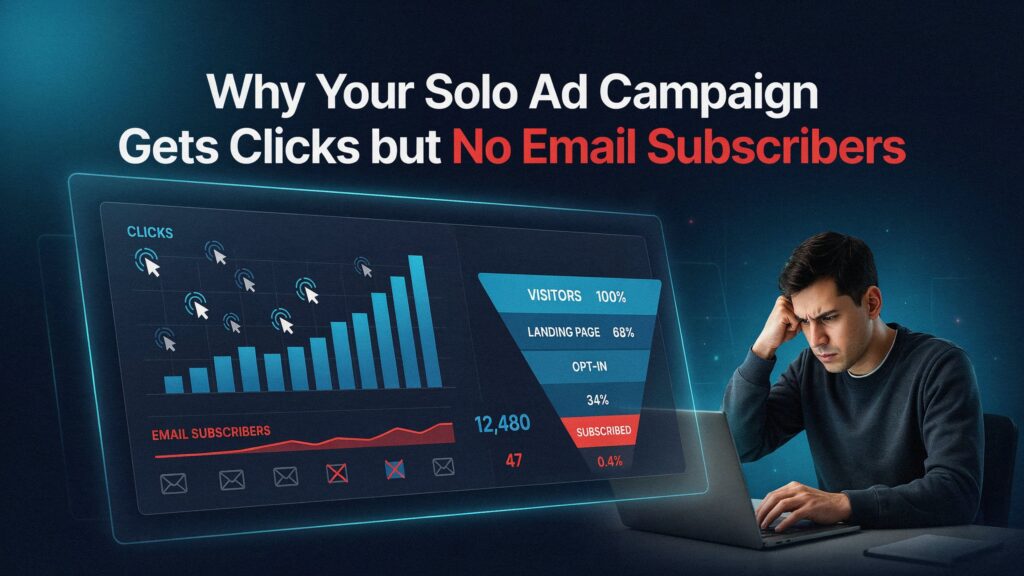
Getting plenty of clicks from a solo ad campaign can feel encouraging—until you check your results and discover that hardly anyone joined your email list. Traffic alone does not guarantee conversions. To consistently generate solo ads email subscribers, your landing page, offer, audience targeting, and follow-up strategy must work together.
If people are clicking but not subscribing, there is usually a disconnect somewhere between the email they received and the page they landed on. Below are seven common reasons this happens and practical ways to fix them.
Table of Contents
Your Ad Message and Landing Page Don't Match
One of the biggest reasons visitors fail to subscribe is message mismatch.
For example, imagine your solo ad swipe promises:
“Discover 5 simple ways to get more affiliate commissions.”
But when visitors click, your landing page immediately starts talking about a complicated software tool or an unrelated business opportunity.
The visitor expected one thing and received another.
This creates confusion and reduces trust. The transition from the solo ad email to your landing page should feel natural. Your headline should continue the same conversation that started inside the email.
For better solo ads email subscribers, make sure these elements match:
- The main promise in your ad
- The problem you mention
- The audience you target
- The benefit on your landing page
- The call to action
For instance, if your email promotes a free guide called “7 Affiliate Marketing Mistakes Beginners Should Avoid,” your landing page headline should clearly mention that same guide.
A consistent message reassures visitors that they landed in the right place. The fewer surprises they encounter, the more likely they are to take the next step.
Your Solo Ads Email Subscribers Don't See Enough Value
People are protective of their email addresses. They will not subscribe simply because a page says, “Join our newsletter.”
You need to give them a clear reason.
Strong solo ads email subscribers growth usually starts with a valuable and specific incentive. This could be:
- A free checklist
- A short guide
- A video training
- A template
- A case study
- A useful email course
- A discount or special offer
The key is specificity.
Compare these two offers:
Weak:
“Subscribe to get marketing tips.“
Stronger:
“Get the 10-minute checklist that helps new affiliate marketers prepare a campaign before buying traffic.”
The second offer tells visitors exactly what they will receive and why it matters.
Before running your next campaign, ask yourself: Would my ideal visitor consider this offer valuable enough to exchange their email address for it?
If the answer is unclear, improve the lead magnet before buying more traffic.
Your Solo Ads Email Subscribers Face a Weak Landing Page Experience
A landing page can either guide visitors toward one simple action or overwhelm them with too many choices.
If you want more solo ads email subscribers, your page should be focused on a single conversion goal: getting the visitor to opt in.
Common landing page problems include:
- Too much text before the form
- Multiple calls to action
- Slow loading speed
- Confusing headlines
- Too many form fields
- Distracting navigation menus
- Poor mobile design
Imagine a visitor arriving from an email on their phone. They have limited time and attention. If the page takes several seconds to load, contains long paragraphs, and asks for their name, phone number, business name, website, and email, many will simply leave.
A simpler structure often works better:
Headline → Main benefit → Short explanation → Proof or supporting points → Opt-in form → Call to action
For example:
Headline:
“Get the Free Checklist Before You Buy Your Next Solo Ad”
Supporting text:
“Learn the 7 things to check before spending money on paid email traffic.”
CTA:
“Send Me the Checklist”
This approach gives visitors a clear reason to subscribe without making them work to understand the offer.
You're Asking for Too Much Information
Every additional form field can create friction.
If your primary goal is list building, asking for only an email address is often the simplest option. In some cases, asking for a first name can also make sense if you plan to personalize future emails.
However, requesting unnecessary information can reduce conversions.
Consider these two forms.
Form A
- First Name
- Last Name
- Phone Number
- Company Name
- Website
- Email Address
Form B
- Email Address
For someone who has just clicked an unfamiliar link, Form B feels faster and safer.
This does not mean you should never collect additional information. If your business model requires qualification, more fields may be necessary. However, for many list-building campaigns, simplicity can help increase the number of people willing to subscribe.
The goal is to remove unnecessary barriers between the visitor and your offer.
The Traffic May Not Match Your Offer
Not all clicks are equal.
You can receive hundreds of visitors, but if those people are not interested in what you are promoting, conversions will remain low.
For example, suppose your offer is designed for experienced affiliate marketers who want advanced lead-generation strategies. If the traffic source mainly consists of complete beginners looking for easy ways to make money online, there may be a significant audience mismatch.
Before buying traffic, clearly define:
- Who is the ideal subscriber?
- What problem are they trying to solve?
- What experience level do they have?
- What type of offers have they shown interest in before?
- Does your lead magnet directly address their needs?
A campaign aimed at generating solo ads email subscribers should not focus only on click volume. Relevance matters more than raw traffic numbers.
A smaller campaign sent to a highly relevant audience can outperform a larger campaign with poorly matched traffic.
Instead of asking, “How many clicks can I get?” ask, “Are these the right people for my offer?”
You Aren't Building Trust With Solo Ads Email Subscribers
Visitors may hesitate to subscribe because they do not know who you are or what will happen after they enter their email address.
Trust is especially important when someone encounters your brand for the first time through paid traffic.
You can make your landing page more credible by including:
- A clear explanation of who is behind the offer
- A real name or brand identity
- Testimonials, where genuine and relevant
- Privacy reassurance
- A brief explanation of what subscribers will receive
- Professional design
- Contact information or an accessible about page
For example, instead of simply saying:
“Enter your email to continue.”
Try:
“Enter your email to receive the free checklist instantly. You’ll also receive practical tips about improving your traffic and conversion strategy. You can unsubscribe anytime.”
This reduces uncertainty.
Trust is not created by adding flashy graphics or exaggerated income claims. It is created by clarity, consistency, and realistic expectations.
When visitors understand what they are signing up for, they are more comfortable taking action.
You're Not Testing Different Elements
A low conversion rate does not always mean the entire campaign has failed. Sometimes one weak element is preventing visitors from subscribing.
The solution is testing.
You can test different versions of:
- Headlines
- Lead magnets
- CTA buttons
- Form length
- Landing page copy
- Images
- Email swipes
- Audience segments
For example, you could run two versions of the same landing page.
Version A:
“Get Free Marketing Tips”
Version B:
“Download the 7-Step Checklist for Preparing Your First Paid Traffic Campaign”
If Version B produces significantly more sign-ups, you have learned that a specific and outcome-focused offer performs better with that audience.
The same principle applies to solo ads email subscribers. Do not assume your first version is the best version.
Change one important element at a time, track the results, and continue improving based on actual data.
Even small improvements in conversion rate can significantly increase the value of your paid traffic over time.
Conclusion
Getting clicks but no subscribers can be frustrating, especially when you have already invested money in traffic. However, the problem is often fixable.
Focus on creating a smooth connection between your ad and landing page, offering something genuinely valuable, reducing friction, targeting the right audience, building trust, and testing your results.
The goal is not simply to buy more clicks. The goal is to turn relevant visitors into solo ads email subscribers who are genuinely interested in hearing from you.
When you improve the conversion process before scaling your campaign, every future click has a better chance of producing meaningful results.
Frequently Asked Questions
What is a good opt-in rate for paid traffic?
Opt-in rates can vary significantly depending on the audience, offer, landing page, and traffic quality. Instead of focusing only on an industry average, track your own campaigns and work on improving your results over time.
Should I use a free lead magnet?
Yes, a relevant lead magnet can give visitors a stronger reason to provide their email address. The best option is something useful that solves a specific problem for your target audience.
How many fields should my opt-in form have?
For simple email list building, fewer fields generally create less friction. An email address alone is often enough unless you need additional information for a specific purpose.
Why do people click but leave immediately?
This can happen because of message mismatch, a slow website, poor mobile experience, an unclear offer, or because the visitor expected something different after clicking.
Should I test more than one landing page?
Yes. Testing different headlines, offers, calls to action, and page structures can help you identify what resonates most with your audience.