Getting people to click your advertisement is only the beginning. The real challenge is turning those visitors into leads, nurturing them, and eventually converting them into paying customers. That’s where a well-designed solo ads funnel becomes valuable.
Instead of sending paid traffic directly to a sales page and hoping visitors buy, you can create a structured journey that guides prospects through each stage of the buying process. With the right landing page, lead magnet, email sequence, offer, and tracking system, every click has an opportunity to become a meaningful business result.
In this guide, you’ll learn how to build a complete funnel that takes prospects from their first click to becoming customers.
Table of Contents
Understand the Journey From Click to Customer
Before building your funnel, understand what happens after someone clicks your advertisement.
A basic customer journey looks like this:
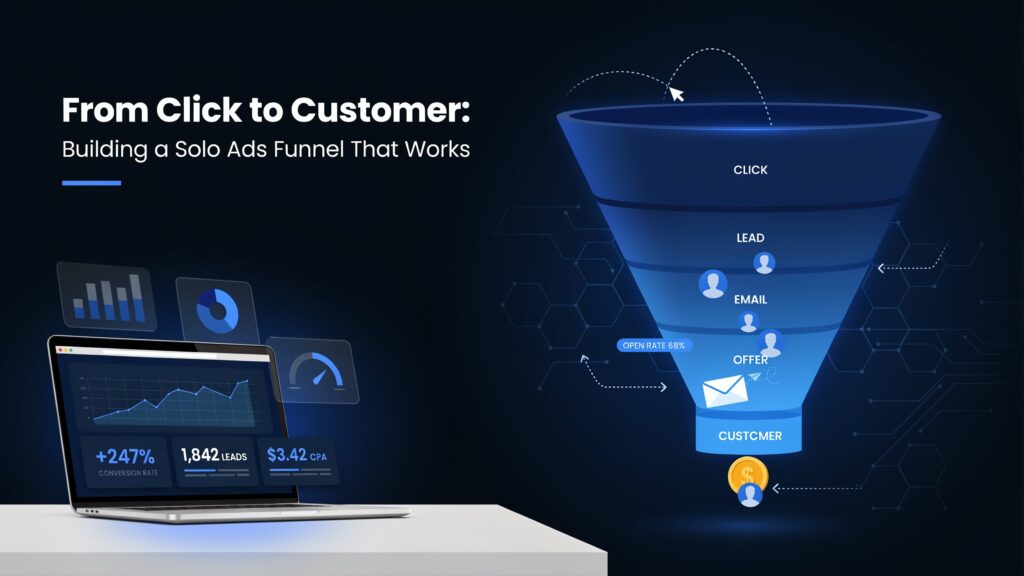
Ad → Landing Page → Lead Capture → Email Follow-Up → Offer → Purchase
Each stage has a specific purpose.
The advertisement attracts attention. The landing page explains the value of your offer. The lead form captures contact information. Email follow-up builds trust. Finally, your offer gives the prospect a reason to buy.
For example, imagine you’re promoting an online marketing course.
Your advertisement might promise:
“Discover 5 Simple Ways to Generate More Leads Online.”
The visitor clicks and reaches a landing page offering a free PDF guide. After entering their email address, they receive the guide and begin an automated email sequence.
Over the next several days, you provide useful information, explain common marketing mistakes, share examples, and introduce your paid course.
This is much more effective than expecting a cold visitor to immediately spend money.
A successful solo ads funnel is therefore less about generating one transaction and more about creating a predictable customer journey.
The most important question is:
What should happen immediately after someone clicks?
If you can answer that clearly, you have the foundation for your funnel.
Build Your Solo Ads Funnel Around a Strong Landing Page
Your landing page is one of the most important components of your solo ads funnel because it determines what happens after the initial click.
A visitor should immediately understand:
- What you’re offering
- Who the offer is for
- What benefit they receive
- What action they should take
- Why they should trust you
Avoid overwhelming visitors with unnecessary navigation, excessive text, or multiple competing calls to action.
For example, suppose you’re offering a free checklist for affiliate marketers.
A weak headline might say:
“Welcome to Our Website.”
It doesn’t give the visitor a reason to continue.
A stronger headline could be:
“Get the 10-Point Affiliate Marketing Checklist for Building Your First Campaign.”
Now the visitor knows exactly what they’re receiving.
Your landing page can include:
A compelling headline
Clearly communicate the primary benefit.
Supporting copy
Explain what the visitor will receive and why it matters.
A simple opt-in form
Ask for only the information you actually need.
Trust elements
Testimonials, statistics, guarantees, or credibility indicators can reduce hesitation when they are genuine.
A clear call to action
Tell visitors exactly what to do next.
For example:
“Get the Free Checklist”
is more specific than:
“Submit.”
The objective is to minimize friction between the initial click and the desired conversion.
Use Your Solo Ads Funnel to Capture and Nurture Leads
A visitor who doesn’t buy immediately isn’t necessarily a lost prospect. Your solo ads funnel should give you a way to continue communicating with interested visitors.
Lead capture is therefore essential.
A useful lead magnet could include:
- A checklist
- Short ebook
- Tutorial
- Template
- Case study
- Video training
- Resource guide
- Free mini-course
The lead magnet should solve a small but meaningful problem for your target audience.
For example, if you’re targeting people who want to grow an email list, you could offer:
“The Beginner’s 7-Day Email List Building Plan.”
Once someone opts in, your automated email sequence can begin.
A simple sequence might look like:
Email 1: Deliver the promised resource.
Email 2: Introduce a common problem.
Email 3: Provide a practical solution.
Email 4: Share a case study or example.
Email 5: Introduce your paid solution.
Email 6: Address common objections.
Email 7: Provide a final call to action.
The purpose isn’t to send endless promotional messages. Your goal is to build credibility and demonstrate that your paid offer provides additional value.
This nurturing stage can dramatically improve the performance of your solo ads funnel because prospects often need more information before making a purchasing decision.
Create an Email Sequence That Builds Trust
Once you’ve captured a lead, email marketing becomes the bridge between initial interest and a potential purchase.
Your emails should have a logical progression rather than consisting of random promotions.
Think of the sequence as a conversation.
Email 1: Deliver value
Give subscribers exactly what they requested.
Email 2: Identify the problem
Explain a challenge your audience commonly experiences.
Email 3: Teach something useful
Provide a practical strategy they can implement.
Email 4: Demonstrate the solution
Use a case study, example, or personal experience to show how the strategy works.
Email 5: Present your offer
Explain how your product or service can help them achieve the desired result.
Email 6: Overcome objections
Address concerns about price, complexity, time, or effectiveness.
Email 7: Encourage action
Give readers a clear next step.
For example, if you’re selling an email automation course, don’t spend every email saying:
“Buy my course.”
Instead, explain why automation matters, show what happens without it, demonstrate a simple workflow, and then explain how your course provides a complete implementation process.
This approach makes your solo ads funnel feel more like a guided educational experience than a sequence of advertisements.
Match Your Offer to the Traffic
Even the best landing page and email sequence cannot compensate for an offer that doesn’t match the audience.
Traffic relevance is critical.
Imagine you sell premium fitness coaching but purchase traffic from an audience primarily interested in cryptocurrency news. You might generate clicks, but conversion rates are likely to be poor because the audience has little connection to your product.
Before launching your solo ads funnel, ask:
“Why would this particular audience want my offer?”
Your offer should align with the reason people clicked your advertisement.
For example:
Ad:
“Learn how to create your first profitable email campaign.”
Landing Page:
“Download the Beginner’s Email Marketing Blueprint.”
Email Sequence:
Education about email marketing.
Paid Offer:
Complete email marketing course.
The messaging is consistent from beginning to end.
Now compare that with:
Ad: Email marketing tips
Landing Page: Cryptocurrency investment guide
Email Sequence: Generic online business promotions
There is a disconnect.
When the message changes dramatically between stages, visitors may become confused or lose trust.
Consistency creates a smoother customer journey and can improve conversions throughout your solo ads funnel.
Track Your Solo Ads Funnel at Every Stage
If you don’t track your solo ads funnel, you won’t know where your campaign is succeeding or failing.
Traffic numbers alone aren’t enough.
You should monitor the major stages of your funnel:
| Metric | What It Tells You |
|---|---|
| Clicks | Traffic volume |
| Landing-page visits | Actual visitors |
| Opt-ins | Lead generation |
| Conversion rate | Page effectiveness |
| Email opens | Subscriber engagement |
| Email clicks | Content interest |
| Sales | Customer conversion |
| Revenue | Financial results |
| Customer acquisition cost | Cost of acquiring customers |
| ROI | Overall profitability |
For example, imagine your campaign produces:
- 1,000 clicks
- 800 landing-page visitors
- 200 leads
- 40 sales
- $2,000 revenue
You can now analyze each stage.
If only 20 people became leads, your landing page may be the problem.
If you generated 200 leads but only one sale, your follow-up sequence, offer, targeting, or sales process may require attention.
Tracking lets you diagnose the actual problem instead of simply buying more traffic.
Use unique tracking links for different traffic sources so you can compare vendors and campaigns accurately.
The goal of your solo ads funnel is not simply to collect data. It’s to use that data to make better decisions.
Optimize Before You Scale Your Campaign
Once your funnel is running, resist the temptation to immediately increase your advertising budget.
First, identify weaknesses.
Suppose you receive 500 visitors and generate only 25 leads.
Your opt-in rate is:
25 ÷ 500 × 100 = 5%
You could test:
- A stronger headline
- A different lead magnet
- Shorter forms
- A clearer CTA
- More relevant copy
- Better trust elements
Now imagine your conversion rate increases to 10%.
The same 500 visitors would generate approximately 50 leads instead of 25.
You doubled your leads without buying additional traffic.
The same principle applies further down the funnel.
If your emails receive strong engagement but sales remain low, test the offer.
If your landing page performs well but email engagement is weak, improve your follow-up content.
If leads convert well but customer acquisition costs are too high, evaluate your traffic source and pricing.
Your solo ads funnel should be treated as an optimization system rather than a one-time setup.
Make one meaningful change at a time, track the results, and compare performance.
Over time, these incremental improvements can significantly increase your return from paid traffic.
Conclusion
Building a profitable funnel requires more than purchasing traffic and counting clicks. You need a structured system that moves prospects from their first interaction toward becoming customers.
A strong solo ads funnel connects every stage: relevant advertising, a focused landing page, valuable lead magnets, strategic email follow-up, a suitable offer, accurate tracking, and continuous optimization.
Start small. Track every stage. Identify where prospects drop out. Then improve that specific part before increasing your advertising budget.
When the journey from click to customer is carefully designed, your paid traffic becomes more than a source of visitors—it becomes a repeatable customer acquisition system. 📈
Frequently Asked Questions?
What is the purpose of a landing page?
A landing page gives visitors a focused destination after they click an advertisement. Its primary purpose is to communicate the offer clearly and encourage a specific action, such as signing up or making a purchase.
Should I send paid traffic directly to my sales page?
It depends on the audience and offer. Cold traffic often benefits from an intermediate step such as a lead magnet or educational page because prospects may need additional information before purchasing.
What makes a good lead magnet?
A strong lead magnet solves a specific problem quickly and provides an obvious benefit. Checklists, templates, guides, tutorials, and short training resources are common examples.
How many emails should I send to new subscribers?
There is no universal number. Start with a structured sequence that delivers value, builds trust, introduces your offer, and addresses common objections. Monitor engagement and adjust the sequence based on results.
What metrics should I monitor?
At minimum, monitor clicks, landing-page conversion rate, leads, email engagement, sales, revenue, customer acquisition cost, and return on investment.