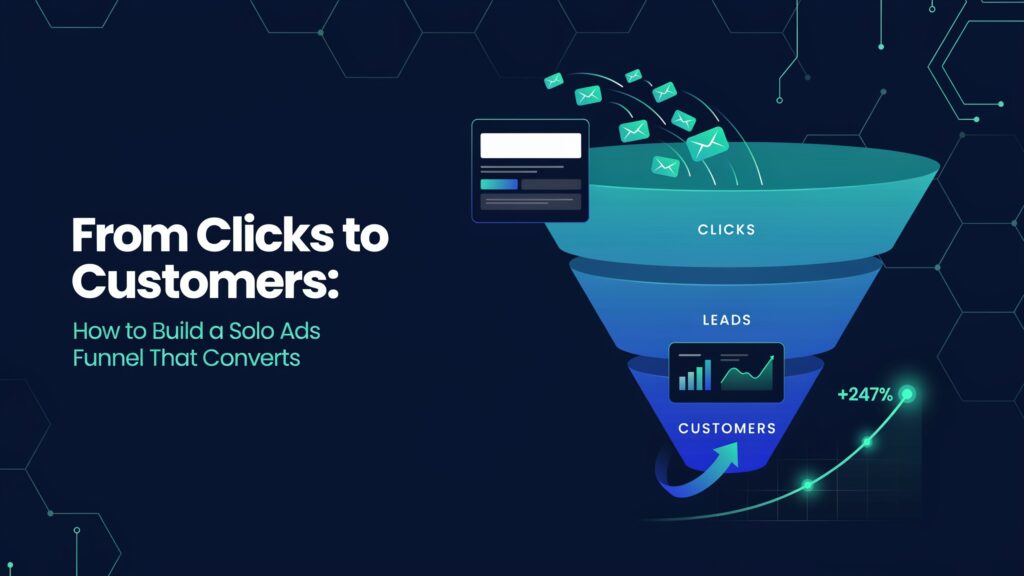
Getting clicks from paid traffic is only the first step. The real goal is to turn those visitors into leads, build trust with them, and eventually convert them into paying customers. That is where a well-planned solo ads funnel becomes important.
Instead of sending every visitor directly to a sales page and hoping they buy, you can create a clear journey that guides prospects from their first click to your offer.
A simple journey might look like this:
Solo Ad → Landing Page → Lead Magnet → Email Follow-Up → Offer → Customer
Each stage has a specific purpose. When those stages work together, you can get more value from the traffic you are already paying for.
Table of Contents
Start With a Clear Customer Journey
Before you spend money on traffic, decide exactly what you want visitors to do after they click.
A basic customer journey could start with your advertisement and move through a landing page, lead magnet, thank-you page, email sequence, and sales offer.
For example, imagine you sell an affiliate marketing course. Instead of sending your paid traffic directly to the course sales page, you could offer a free guide called “7 Steps to Your First Affiliate Sale.”
The visitor clicks your ad, lands on the page, enters their email address, receives the guide, and then begins receiving useful emails.
Your emails can gradually educate the subscriber about affiliate marketing before introducing the paid course.
This approach gives you multiple opportunities to build a relationship with the prospect.
Before launching your campaign, ask yourself:
- What happens immediately after the click?
- What action should the visitor take?
- What happens after they submit the form?
- How will you follow up?
- What is the final offer?
If you cannot clearly answer these questions, your funnel probably needs more planning.
Build Your Solo Ads Funnel Around One Strong Landing Page
Your landing page is one of the most important parts of your solo ads funnel because this is where paid traffic becomes an opportunity to generate leads.
Avoid sending visitors to a general homepage filled with different products, menus, links, and distractions.
Instead, create a focused landing page with one primary objective.
Your page should generally include:
- A clear headline
- A strong value proposition
- Short and relevant supporting copy
- A simple opt-in form
- A clear call to action
- Trust-building elements
- Relevant images or visuals
For example, instead of using a generic headline such as:
“Welcome to Our Website”
you could write:
“Get the Free 10-Step Guide to Building Your First Profitable Email Funnel.”
The second headline immediately tells visitors what they will receive and why they should care.
Your landing page should also match the message from your advertisement. If your ad promises a free checklist but your landing page talks about a completely different offer, visitors may become confused and leave.
For more information on creating effective landing pages, you can explore Unbounce’s landing page guide.
Use Your Solo Ads Funnel to Capture and Nurture Leads
Not every visitor who clicks your advertisement will be ready to buy immediately.
This is especially common with cold traffic.
Instead of considering every non-buyer a lost opportunity, your solo ads funnel should give interested visitors a reason to provide their email address.
A lead magnet can work well for this purpose.
Examples include:
- Free ebooks
- Checklists
- Templates
- Case studies
- Video tutorials
- Free reports
- Short courses
- Resource guides
For example, suppose you sell an SEO course.
Your advertisement could promote a free SEO Keyword Research Checklist. Visitors click the ad, reach your landing page, enter their email address, and receive the checklist.
You can then introduce them to your brand through a sequence of useful emails.
The first email can deliver the resource.
The second can explain a common SEO mistake.
The third can provide a practical strategy.
The fourth can introduce a case study.
The fifth can explain how your paid product can help them go further.
This process allows you to build trust before asking for the sale.
Match Your Offer With the Traffic You Buy
Even the best funnel cannot completely fix irrelevant traffic.
Imagine you are selling a premium business coaching program but purchase traffic from an audience that has little interest in entrepreneurship or business growth.
You may receive plenty of clicks, but those visitors are unlikely to become customers.
Your advertisement, landing page, lead magnet, emails, and offer should therefore target the same audience and communicate a consistent message.
For example:
Advertisement:
“Discover 5 Ways to Generate More Email Leads”
Landing Page:
“Download the Free Email Lead Generation Checklist”
Follow-Up:
“Learn How to Turn New Subscribers Into Customers”
Offer:
“Complete Email Marketing Training”
Each step naturally leads to the next.
That consistency makes the solo ads funnel easier for prospects to understand.
Before buying traffic, ask one important question:
“Why would this audience be interested in my offer?”
If the answer is unclear, you may need to improve your targeting before increasing your advertising budget.
Create a Follow-Up Sequence That Builds Trust
An email opt-in does not automatically mean you have a customer.
Some subscribers may need days or even weeks to understand your offer and decide whether it is right for them.
Your follow-up sequence should therefore educate, build credibility, address problems, and eventually present your offer.
A simple sequence could look like:
Email 1: Deliver the promised lead magnet
Email 2: Explain the main problem your audience faces
Email 3: Provide a useful solution
Email 4: Share a case study or example
Email 5: Introduce your product or service
Email 6: Address common objections
Email 7: Give subscribers a clear reason to take action
The goal isn’t to send endless promotional emails.
Instead, each message should move the subscriber one step closer to understanding the problem and recognizing your solution.
For example, if your audience struggles to generate leads, you could first explain why their current strategy isn’t producing results. Then provide a practical improvement and eventually show how your product can help them implement the complete system.
This makes your solo ads funnel feel like a guided customer journey rather than a collection of advertisements.
Track Your Solo Ads Funnel From Click to Sale
Clicks are useful, but they don’t tell you whether your campaign is profitable.
To understand your actual performance, track what happens after the click.
Important metrics include:
- Clicks
- Landing-page visitors
- Opt-ins
- Conversion rate
- Email engagement
- Sales
- Revenue
- Customer acquisition cost
- Return on investment
Consider a simple example.
You purchase traffic that produces 500 clicks.
Those clicks generate 100 leads.
From those leads, 20 people purchase your product.
Now you have much more useful information than simply knowing you received 500 clicks.
You can analyze each stage and identify potential weaknesses.
If you receive plenty of clicks but very few leads, your landing page may need improvement.
If you generate many leads but very few sales, your email sequence, offer, or sales page could be the problem.
Tracking your solo ads funnel from beginning to end makes optimization much more precise.
Solo Ad Hub also provides additional guidance on measuring solo ad campaign success, including why looking beyond basic click numbers is important.
Test, Improve, and Scale Your Funnel Gradually
Your first funnel will rarely be perfect.
Instead of trying to build everything perfectly from the beginning, launch, collect data, and improve the areas that need attention.
You can test different elements such as:
- Headlines
- Lead magnets
- Call-to-action text
- Landing-page layouts
- Email subject lines
- Email sequences
- Offers
- Sales-page copy
For example, imagine that your first landing page generates a 15% opt-in rate.
You test a new headline and improve the conversion rate to 22%.
That small change could make a significant difference when you are purchasing hundreds or thousands of clicks.
However, avoid changing everything at once.
If you change your headline, form, CTA, lead magnet, and offer simultaneously, you may not know which change actually improved your results.
Instead, test one important variable at a time.
Once you have a solo ads funnel that consistently produces leads and sales, you can gradually increase your traffic volume.
Scaling should happen after validation—not before.
Conclusion
A successful solo ads funnel is about much more than generating clicks.
The real objective is to create a connected journey that moves visitors from:
Traffic → Landing Page → Lead → Follow-Up → Offer → Customer
Start with a clear customer journey. Build a focused landing page, provide a valuable lead magnet, nurture your subscribers, match your offer with the right audience, and track the complete customer journey.
Most importantly, don’t judge your campaign only by the number of clicks it generates.
A campaign becomes valuable when those clicks turn into qualified leads, customers, revenue, and sustainable ROI.
With continuous testing and optimization, a properly structured solo ads funnel can become a repeatable customer acquisition system instead of simply another source of website traffic. 📈
Frequently Asked Questions
What is a sales funnel?
A sales funnel is a series of steps that guides potential customers from their first interaction with a business toward a desired action, such as submitting their information or making a purchase.
Should I send paid traffic directly to my sales page?
Not necessarily. Cold visitors may need more information and trust before making a purchase. A landing page and lead magnet can provide an easier first step.
What makes a good lead magnet?
A good lead magnet solves a specific problem for your target audience and provides a clear benefit. Checklists, templates, guides, reports, and short training resources are common examples.
How many emails should I include in a follow-up sequence?
There is no fixed number. Your sequence should contain enough messages to provide value, establish trust, explain your offer, and handle common objections.
What metrics should I track?
Track clicks, leads, landing-page conversion rate, email engagement, sales, revenue, customer acquisition cost, and ROI.