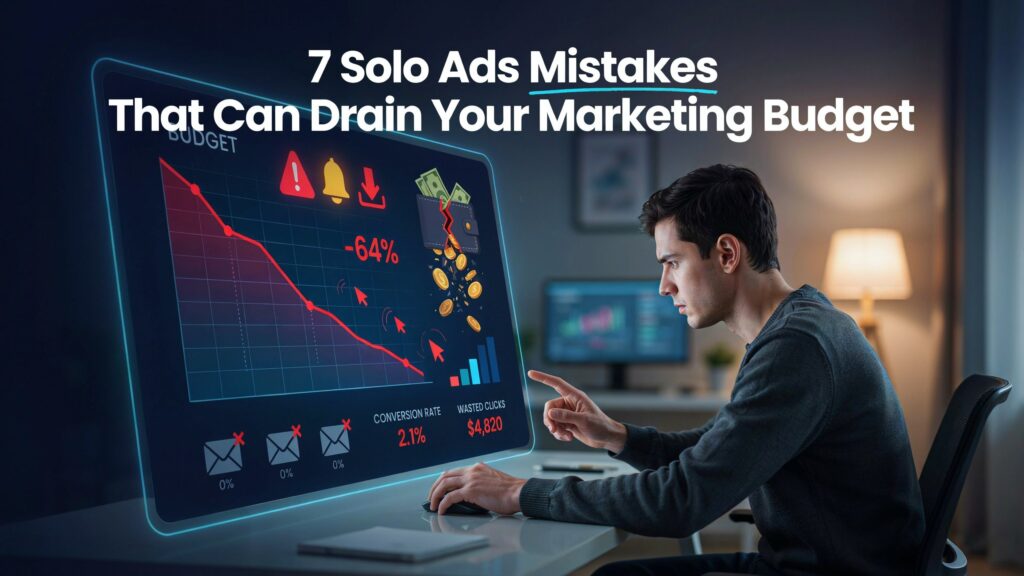
Solo ads can be a fast way to put your offer in front of a targeted email audience. However, rushing into a campaign without the right strategy can turn paid traffic into wasted money. The most common solo ads mistakes usually involve poor vendor selection, weak landing pages, unclear offers, and inadequate tracking.
Whether you are an affiliate marketer, coach, course creator, or online business owner, understanding these mistakes can help you protect your advertising budget. More importantly, avoiding them can improve lead quality and give you better data for future campaigns.
Let’s look at seven costly errors and how to avoid them.
Table of Contents
Choosing a Solo Ads Vendor Based Only on Price
One of the biggest solo ads mistakes is choosing the cheapest vendor without investigating the quality of their traffic.
A low price can look attractive when you are working with a limited advertising budget. But cheap clicks are not necessarily valuable clicks. If the audience is inactive, poorly targeted, or repeatedly exposed to promotional offers, your campaign may generate traffic without producing meaningful leads or sales.
For example, imagine two vendors:
- Vendor A offers 500 clicks for $150.
- Vendor B offers 500 clicks for $300.
Vendor A looks like the obvious bargain. However, suppose Vendor A produces only 15 leads, while Vendor B produces 75 leads from the same number of clicks.
The cheaper campaign actually costs more per lead.
Before purchasing traffic, investigate the vendor’s niche, audience relevance, reputation, testimonials, campaign reporting, and communication process. Ask what type of audience receives your promotion and whether the traffic is appropriate for your offer.
The goal is not to find the cheapest clicks. It is to find relevant traffic that has a realistic chance of becoming customers.
Solo Ads Mistakes: Sending Traffic to a Weak Landing Page
One of the most expensive solo ads mistakes happens after the visitor clicks.
You can purchase high-quality traffic, but if your landing page is confusing, slow, poorly designed, or disconnected from the advertisement, visitors may leave without taking action.
Think about the journey from the subscriber’s perspective. They receive an email promising a useful solution. They click the link because the message interests them. Your landing page then needs to deliver exactly what they expected.
For example, suppose your email promotes a free guide called “10 Ways to Build an Email List.” The landing page should immediately reinforce that promise.
A strong page might include:
- A clear headline matching the email’s promise
- One primary call to action
- A short explanation of the benefit
- A simple opt-in form
- Trust-building elements
- Minimal distractions
Avoid sending paid traffic directly to a cluttered homepage with multiple menus, unrelated products, and several competing calls to action.
A dedicated landing page gives visitors a clear next step and makes campaign performance easier to measure.
Before launching traffic, test your page on both desktop and mobile devices. Check the loading speed, form functionality, headline, call to action, and overall user experience.
Solo Ads Mistakes: Focusing on Clicks Instead of Conversions
Another major problem is treating clicks as the primary measure of campaign success.
Clicks tell you that someone visited your page. They do not tell you whether that person became a subscriber, customer, or profitable lead.
This is one of the most important solo ads mistakes to understand because a campaign can generate hundreds of clicks and still perform poorly.
Imagine a campaign that produces:
- 500 clicks
- 20 leads
- 2 sales
Now compare it with another campaign:
- 300 clicks
- 90 leads
- 8 sales
The second campaign generated fewer clicks but produced significantly better business results.
Track the entire funnel instead of stopping at traffic volume. Important metrics include click-through rate, landing page conversion rate, cost per lead, sales conversion rate, customer acquisition cost, and revenue.
For example, if you spend $250 and generate 50 leads, your cost per lead is $5. If those leads eventually generate $700 in revenue, the campaign deserves a very different evaluation than a campaign that generates the same number of leads but only $100 in revenue.
Always ask: What happened after the click?
That question gives you much more useful information than traffic volume alone.
Promoting an Offer That Does Not Match the Audience
Audience relevance plays a huge role in paid traffic performance.
One of the common solo ads mistakes is assuming that any email audience will respond to any offer. It does not work that way.
Imagine you are promoting a software tool for ecommerce businesses. Sending the offer to an audience primarily interested in personal development may produce clicks from curious subscribers, but the likelihood of qualified conversions could be low.
The better approach is to match three elements:
Audience → Problem → Offer
If the audience consists of beginner affiliate marketers, an offer related to affiliate marketing tools, training, or resources may be more relevant.
Before purchasing a campaign, research the vendor’s audience and compare it with your ideal customer profile.
Ask questions such as:
- Who is the audience?
- What niche does the list focus on?
- What problems are subscribers trying to solve?
- What types of offers have historically performed well?
- Does the audience match your buyer persona?
The closer the audience matches the problem your offer solves, the more likely your traffic will be useful.
Writing an Email That Does Not Give People a Reason to Click
Your promotional email is the bridge between the vendor’s audience and your landing page.
Another frequent solo ads mistakes issue is creating an email that talks too much about the product and not enough about the reader’s problem.
A subscriber usually does not care about a long list of product features. They care about what the product can help them achieve.
Instead of writing:
“Our platform includes 25 advanced features, automated reporting, integrations, and analytics.”
Consider focusing on the outcome:
“Want a simpler way to organize your marketing campaigns and see which traffic sources are actually producing leads?”
The second approach creates curiosity and connects the offer with a potential problem.
A good promotional email generally needs:
- An attention-grabbing opening.
- A clear problem or opportunity.
- A relevant benefit.
- Enough information to create curiosity.
- A clear call to action.
Avoid making unrealistic promises or using exaggerated claims. A message that attracts irrelevant clicks can increase traffic while decreasing lead quality.
Your goal should be qualified curiosity, not maximum clicks at any cost.
Solo Ads Mistakes: Failing to Test Before Scaling
Scaling a campaign before understanding its performance is another expensive mistake.
Among the most avoidable solo ads mistakes, this one can quickly multiply losses. If a campaign is not converting at a small budget, spending five or ten times more will not automatically fix it.
Suppose you purchase 100 clicks as an initial test. Your landing page converts only 3% of visitors into leads.
Instead of immediately purchasing 1,000 more clicks, investigate why the conversion rate is low.
You could test:
- A stronger headline
- A different lead magnet
- A shorter opt-in form
- A clearer call to action
- Better email-to-landing-page alignment
- A different vendor or audience segment
After identifying a stronger combination, increase the traffic gradually.
Testing gives you information. Scaling multiplies the results of that information—whether those results are good or bad.
A disciplined testing process protects your budget and makes it easier to identify what actually drives conversions.
Ignoring Follow-Up After Capturing Leads
Getting someone onto your email list is only the beginning.
A surprisingly common problem is spending money to acquire leads and then failing to nurture them properly. This means your campaign may appear unprofitable even when the initial traffic is capable of producing valuable customers over time.
Consider a subscriber who downloads your free guide today. They may not be ready to purchase immediately. But a well-designed follow-up sequence can educate them, build trust, answer common questions, and introduce relevant offers.
For example, a simple sequence might look like this:
Day 1: Deliver the promised resource.
Day 2: Share a useful strategy related to the problem.
Day 4: Explain a common mistake and how to avoid it.
Day 6: Introduce a relevant solution.
Day 8: Share an example or case study.
Day 10: Make a clear offer.
The exact sequence will depend on your audience and business model, but the principle is the same: don’t treat every lead as an immediate buyer.
Your follow-up system can have a major impact on the overall value of your paid traffic.
Conclusion
Avoiding solo ads mistakes can make a significant difference in how efficiently you use your marketing budget. Choosing a vendor based solely on price, using a weak landing page, focusing only on clicks, mismatching your offer with the audience, writing ineffective emails, scaling too quickly, and neglecting follow-up can all reduce your campaign’s potential.
The solution is a complete funnel-based approach.
Choose relevant traffic, create a strong offer, send visitors to a focused landing page, track conversions, test with a controlled budget, and nurture the leads you generate.
Remember that successful paid traffic is rarely about getting the most clicks. It is about turning the right clicks into valuable leads and customers.
By identifying solo ads mistakes before launching your campaign, you can make better decisions, reduce wasted spending, and build a more predictable traffic strategy.
Frequently Asked Questions
Are solo ads suitable for beginners?
Yes. They can be relatively easy to test because you can work with an established email audience. Beginners should start with a small test campaign and carefully monitor results before increasing their budget.
How do I choose a reliable traffic provider?
Look for relevant audience targeting, transparent campaign information, positive customer feedback, clear communication, and evidence that the provider understands your niche. Avoid choosing a provider based only on the lowest price.
What is a good landing page conversion rate?
There is no universal benchmark because conversion rates vary by niche, offer, audience, traffic source, and funnel. Instead of relying on one number, establish a baseline and continuously test improvements.
Should I send paid traffic directly to my sales page?
It depends on your offer and funnel. In many cases, a dedicated landing page or lead magnet can help capture and nurture prospects before presenting a higher-priced product.
How much should I spend on a test campaign?
Use an amount that you can comfortably afford to lose while gathering data. A small controlled campaign is generally better than committing a large budget before understanding how the traffic performs.