Solo advertising can be a powerful way to generate targeted traffic, grow an email list, and introduce your offer to a new audience. However, even a well-funded campaign can underperform when basic strategy errors are overlooked.
The problem with many solo ads mistakes is that they are not always obvious. Your campaign may generate plenty of clicks while quietly losing money because visitors do not convert, leads are poorly targeted, or your tracking is incomplete.
For example, getting 1,000 clicks may sound impressive. But if only 20 people become leads and one person purchases, the traffic volume doesn’t tell the whole story.
The good news is that most of these problems can be identified and corrected. Below are seven common mistakes that can reduce your return on investment and what you can do instead.
Table of Contents
Buying Traffic Based Only on the Lowest Price
One of the most common solo ads mistakes is choosing a vendor simply because they offer the cheapest clicks or subscribers.
A low price can be attractive, especially when you’re working with a limited advertising budget. However, traffic price and traffic value are two different things.
Imagine two vendors:
| Metric | Vendor A | Vendor B |
|---|---|---|
| Cost | $100 | $200 |
| Clicks | 500 | 500 |
| Leads | 30 | 100 |
| Customers | 2 | 10 |
| Revenue | $100 | $600 |
Vendor A appears cheaper at first. But Vendor B produces significantly more customers and revenue.
The better question isn’t:
“How cheaply can I buy traffic?”
Instead, ask:
“How much profitable revenue can this traffic generate?”
Before purchasing, investigate the vendor’s audience, niche, traffic sources, targeting, previous campaign performance, and reputation.
Start with a smaller test campaign when working with a new vendor. This allows you to evaluate traffic quality without exposing your entire advertising budget to unnecessary risk.
The cheapest traffic is not always the most economical traffic.
Ignoring Targeting Is One of the Biggest Solo Ads Mistakes
Audience relevance is critical to campaign performance. One of the most damaging solo ads mistakes is assuming that a large audience automatically means a valuable audience.
Imagine you sell an advanced email marketing course. Your ideal prospects are entrepreneurs, affiliate marketers, creators, and small business owners interested in building email lists.
Now imagine purchasing traffic from a broad audience that has little interest in marketing.
You might still receive hundreds of clicks. However, those visitors may have little motivation to subscribe or purchase.
Targeting affects the entire funnel:
Relevant Audience → Higher Engagement → More Leads → More Sales
When the audience is poorly matched, every downstream metric can suffer.
Before buying traffic, ask:
- Who is actually receiving the email?
- What niche does the audience follow?
- How was the list built?
- How engaged are subscribers?
- Does the audience match my offer?
- Has the vendor worked with similar businesses?
For example, a fitness offer should ideally reach people interested in health, exercise, nutrition, or wellness rather than a completely unrelated audience.
The closer the audience matches the problem your product solves, the greater the potential for meaningful conversions.
Sending Traffic to a Weak Landing Page Is Among the Costliest Solo Ads Mistakes
Even high-quality traffic can fail when visitors arrive on a poorly designed landing page. This is another major category of solo ads mistakes because marketers sometimes blame the traffic before checking their own conversion process.
Suppose 1,000 people visit your landing page.
If the page converts at 3%, you generate:
1,000 × 3% = 30 leads
Now improve the page and increase the conversion rate to 8%.
You generate:
1,000 × 8% = 80 leads
You received exactly the same traffic, but the improved page generated 50 additional leads.
A strong landing page should have:
A clear headline
Tell visitors immediately what they can gain.
A relevant offer
The landing-page promise should match the advertisement that brought the visitor there.
Minimal distractions
Avoid unnecessary menus, excessive links, and competing calls to action.
A compelling CTA
Tell visitors exactly what to do next.
Trust elements
Testimonials, case studies, guarantees, or credibility signals can help reduce hesitation when they are authentic.
For example, instead of using a generic CTA such as “Submit,” try something more benefit-focused such as “Get the Free Marketing Guide.”
Test your headline, offer, CTA, page structure, and form length rather than assuming your first version is perfect.
Focusing on Clicks Instead of Conversions
Another frequent mistake is treating clicks as the primary definition of campaign success.
Clicks are useful because they tell you whether people are visiting your page. But they don’t tell you whether those visitors are becoming subscribers or customers.
Consider this example:
Campaign A
- 1,000 clicks
- 50 leads
- 3 customers
Campaign B
- 600 clicks
- 120 leads
- 15 customers
Campaign A generated more traffic, but Campaign B produced substantially better business results.
This is why solo ads mistakes often happen when marketers optimize for vanity metrics rather than financial outcomes.
Track the complete customer journey:
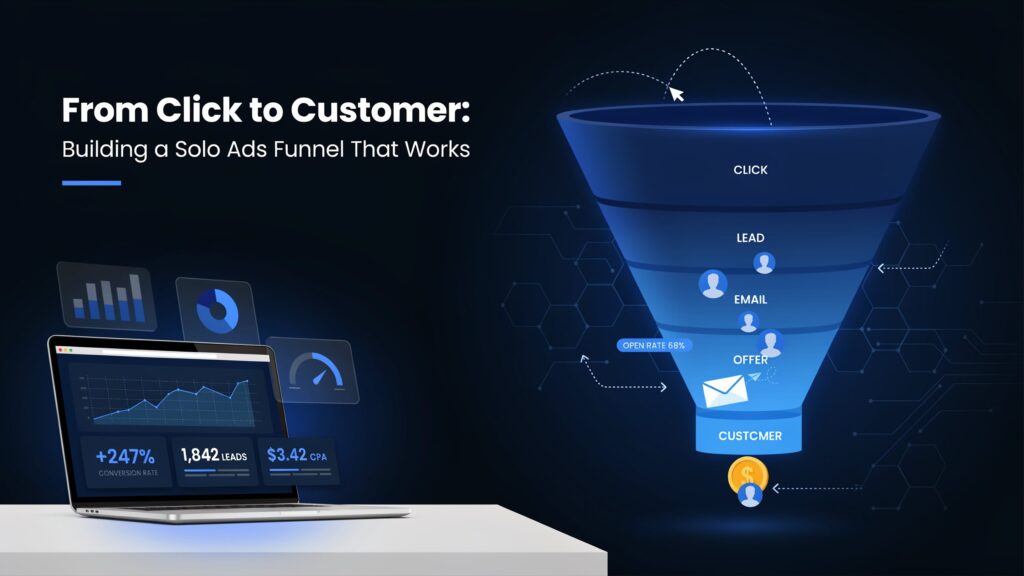
Clicks → Visitors → Leads → Email Engagement → Sales → Revenue
Useful metrics include:
- Landing-page conversion rate
- Cost per lead
- Email open rate
- Email click-through rate
- Sales conversion rate
- Customer acquisition cost
- Revenue
- ROI
For example, if one vendor generates 1,000 clicks but only 10 customers while another produces 500 clicks and 15 customers, the second vendor may be the better investment.
Traffic volume is only the beginning of the analysis.
Failing to Follow Up With New Leads
A person who joins your email list today may not be ready to purchase today.
Ignoring follow-up is one of the most expensive solo ads mistakes because valuable leads can disappear simply because there is no structured communication after the initial signup.
Imagine someone downloads your free guide. You send the guide and then never contact them again.
That person may have been interested in your product but needed additional information before purchasing.
A follow-up sequence could include:
Day 1: Deliver the promised resource.
Day 2: Explain a common problem.
Day 3: Provide a useful strategy.
Day 4: Share a case study.
Day 5: Introduce your product.
Day 6: Answer common objections.
Day 7: Present a clear call to action.
The exact sequence depends on your audience and offer, but the principle remains the same: don’t waste the opportunity you’ve already paid to create.
Your follow-up should provide value rather than turning every email into a hard sales pitch.
For example, if your product helps people generate leads, your emails might teach simple lead-generation techniques before introducing your complete paid solution.
Good follow-up can turn an initially unresponsive subscriber into a qualified prospect.
Poor Tracking Can Hide Serious Solo Ads Mistakes
Without accurate tracking, you may not even realize you’re making solo ads mistakes.
Suppose you purchase traffic from three vendors:
- Vendor A
- Vendor B
- Vendor C
All three generate clicks and leads.
But if all traffic uses the same generic link, you may struggle to determine which vendor actually generated your sales.
Use unique tracking URLs or campaign parameters for each traffic source.
For example:
Vendor A → tracking link A
Vendor B → tracking link B
Vendor C → tracking link C
Now you can compare:
| Metric | Vendor A | Vendor B | Vendor C |
|---|---|---|---|
| Clicks | 500 | 500 | 500 |
| Leads | 50 | 90 | 35 |
| Sales | 4 | 12 | 2 |
| Revenue | $200 | $720 | $100 |
Vendor B clearly deserves closer attention.
You should also monitor performance beyond the first conversion.
Track:
- Lead quality
- Email engagement
- Sales
- Refunds
- Revenue
- Customer acquisition cost
- Return on investment
Accurate tracking turns advertising from guesswork into measurable decision-making.
If you don’t know where your customers originated, it becomes difficult to identify which traffic sources deserve more budget.
Scaling Before You Have a Profitable Campaign
One of the most dangerous solo ads mistakes is increasing your budget before proving that your funnel works.
Imagine you spend $100 on a test campaign and generate $50 in profit.
Instead of analyzing the results, you immediately increase spending to $1,000.
If the underlying problem was poor conversion, you’ve simply multiplied the problem.
A better approach is:
Step 1: Test
Start with a manageable budget.
Step 2: Measure
Track clicks, leads, sales, revenue, and costs.
Step 3: Diagnose
Identify where prospects are dropping out.
Step 4: Optimize
Improve the weakest part of the funnel.
Step 5: Retest
Run another controlled campaign.
Step 6: Scale
Increase spending only when the numbers support it.
For example, if a $200 campaign generates $600 in revenue and your overall costs still leave you with a healthy profit margin, you have evidence worth exploring further.
However, scaling should happen gradually. Increasing your budget too aggressively can also change the traffic mix, audience quality, or campaign economics.
Successful scaling is based on repeatable performance, not excitement over one successful campaign.
Conclusion
The biggest solo ads mistakes are rarely caused by one catastrophic decision. More often, ROI slowly disappears through a combination of poor targeting, weak landing pages, inadequate follow-up, incomplete tracking, and premature scaling.
The solution is to treat every campaign as a measurable funnel.
Start by choosing relevant traffic. Create a landing page that converts. Capture leads, nurture them with useful follow-up, and track the journey all the way to revenue.
Most importantly, don’t judge a campaign by clicks alone. A smaller number of highly relevant visitors can be more valuable than thousands of low-quality clicks.
By identifying and eliminating these seven solo ads mistakes, you can make better advertising decisions, reduce wasted spending, and build a more predictable path from traffic to revenue. 📈
Frequently Asked Questions ?
How do I know whether a traffic vendor is reliable?
Review their audience information, campaign history, communication, transparency, and customer feedback. Start with a small test before committing a significant budget.
What should I track during a campaign?
Monitor clicks, landing-page visits, leads, conversion rates, email engagement, sales, revenue, acquisition costs, and ROI.
How can I improve my landing-page conversion rate?
Test your headline, offer, CTA, form length, page structure, benefits, and trust elements. Make one significant change at a time so you can identify what improves performance.
Why aren't my leads becoming customers?
Possible reasons include poor audience targeting, an unclear offer, weak follow-up, pricing issues, lack of trust, or a mismatch between the advertisement and the product.
How much should I spend on a test campaign?
Use an amount you can afford to lose while collecting enough data to evaluate traffic quality and conversion performance. A controlled test is generally preferable to committing your full budget immediately.