Running a solo ad campaign can be a fast way to generate targeted traffic, but mistakes can quickly turn a promising campaign into wasted ad spend. Many marketers focus heavily on getting clicks while overlooking the small decisions that determine whether those clicks become leads and customers.
The good news is that most solo ads mistakes are avoidable. With better targeting, stronger offers, proper tracking, and a systematic testing process, you can reduce unnecessary losses and improve your campaign performance.
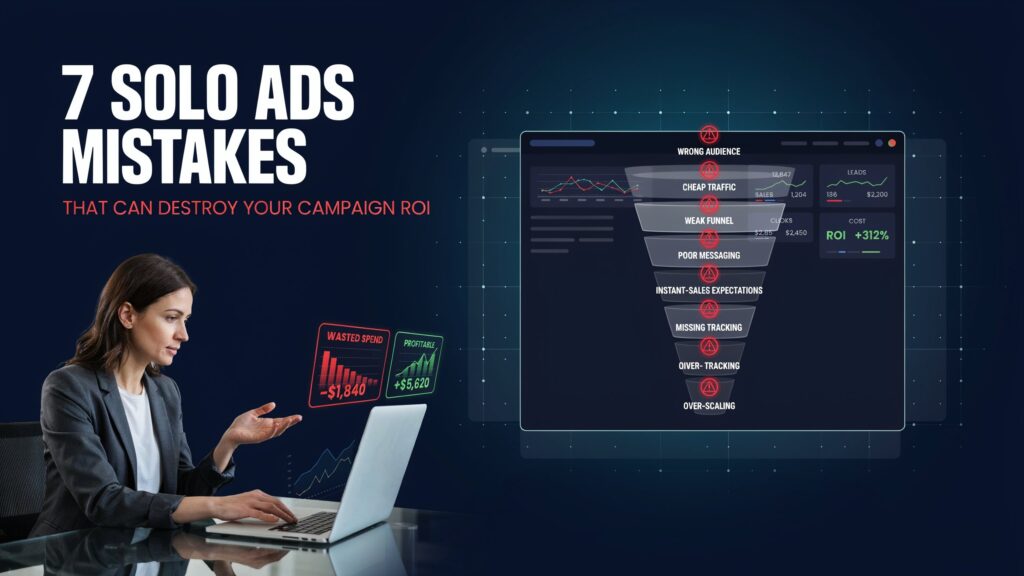
In this guide, we’ll cover seven common solo ads mistakes that can quietly damage your ROI and explain what you can do instead.
Table of Contents
1. Buying Traffic Before Understanding Your Audience
One of the most expensive solo ads mistakes is purchasing traffic before understanding who you actually want to reach.
A vendor may promise a large number of clicks, but those clicks are only valuable when they come from people who have a genuine interest in your offer.
Before buying traffic, define your ideal customer.
Ask:
- What niche are they interested in?
- What problem are they trying to solve?
- What type of products do they already buy?
- Are they beginners or experienced marketers?
- What price range are they comfortable with?
- What action do you want them to take?
For example, suppose you sell an advanced affiliate marketing course. A list made up of people interested in affiliate marketing and online business is likely to be more relevant than a general entertainment audience.
Audience relevance should influence your vendor selection, email copy, landing page, and offer.
If you skip this step, you may receive plenty of clicks but very few qualified leads.
The best campaign begins before you purchase a single click. It begins with understanding exactly who you want those clicks to come from.
2. One of the Biggest Solo Ads Mistakes Is Choosing the Cheapest Vendor
Price is important, but choosing a vendor based only on cost is one of the most common solo ads mistakes.
A vendor offering 500 clicks for $50 may appear more attractive than one charging $150 for the same number of clicks. But if the cheaper traffic produces almost no leads or sales, you have not actually saved money.
Consider this example:
Vendor A:
- Cost: $50
- Clicks: 500
- Leads: 15
- Sales: 1
Vendor B:
- Cost: $150
- Clicks: 500
- Leads: 80
- Sales: 8
Vendor B costs three times more but produces eight times as many sales.
This is why you should compare vendors using business metrics rather than click price alone.
Look for:
- Audience relevance
- List engagement
- Vendor reputation
- Tracking transparency
- Previous customer feedback
- Traffic quality
- Replacement policies
- Campaign performance
Cheap traffic is not necessarily bad, but extremely low pricing should encourage you to ask more questions.
A professional vendor should be able to explain what you are buying and what you can reasonably expect from the traffic.
The goal is not to find the cheapest clicks. The goal is to find traffic that can produce profitable results.
3. Sending Traffic Without Fixing Your Funnel Is Another Solo Ads Mistake
One of the most damaging solo ads mistakes is buying traffic before your funnel is ready.
Your solo ad does not operate independently. Visitors move through a sequence:
Email → Click → Landing Page → Opt-In → Follow-Up → Offer → Sale
If one stage is weak, the entire campaign can suffer.
For example, imagine you purchase 500 clicks and send them to a landing page with:
- A confusing headline
- Too many links
- A slow loading speed
- No clear benefit
- A weak call-to-action
- No trust signals
Even excellent traffic may struggle to convert.
Before launching your campaign, test the complete customer journey.
Ask yourself:
Can visitors immediately understand the offer?
Is the call-to-action obvious?
Does the page work properly on mobile?
Is the opt-in form simple?
Does the thank-you page load correctly?
Does the follow-up sequence begin automatically?
A well-prepared funnel gives every visitor a clear next step.
If you need a deeper look at how a funnel should turn traffic into customers, you can read Solo Ads ROI: 7 Steps to Turn $50 Into $500.
The objective is simple: don’t buy traffic first and fix your funnel later. Make sure your funnel is ready before the traffic arrives.
4. Using the Same Message for Every Audience
Another common problem is assuming that one email message will work equally well for every audience.
Different audiences have different interests, experience levels, pain points, and buying motivations.
For example, an email targeting experienced affiliate marketers might discuss conversion optimization, while a message for beginners might focus on building a first email list.
If the message feels irrelevant, people may ignore it even when the offer itself is valuable.
Your email should clearly connect:
Audience → Problem → Solution → Action
For example:
“Struggling to generate qualified leads?”
This opening identifies a specific problem.
Then:
“Discover a simple system for turning targeted traffic into subscribers.”
Now the reader understands the proposed solution.
Finally:
“Click here to see how it works.”
The call-to-action provides a clear next step.
Relevance is particularly important with email because subscribers are constantly deciding which messages deserve their attention.
A useful approach is to adapt your message based on the audience’s niche and level of awareness rather than sending the exact same copy everywhere.
5. Expecting Immediate Sales From Every Click
Expecting every solo ad campaign to produce immediate sales is another mistake that can lead to poor decisions.
A visitor may click your email but not be ready to purchase immediately.
They may need:
- More information
- Social proof
- Product demonstrations
- Testimonials
- Multiple follow-up emails
- Answers to objections
- More time to evaluate the offer
This is why your campaign should not always be judged only by what happens on the first day.
For example:
Day 1:
500 clicks → 100 subscribers → 1 sale
Over the next two weeks:
100 subscribers → additional emails → 6 more sales
If you judged the campaign immediately after Day 1, you might incorrectly conclude that the traffic was unsuccessful.
Instead, establish a measurement period that matches your sales cycle.
Build a follow-up sequence that continues providing value after the initial opt-in.
Email marketing experts also emphasize that mistakes in timing, content, targeting, and process can undermine campaign performance. Mailchimp’s guide to common email marketing mistakes provides additional guidance on testing, list quality, engagement, and optimization.
The initial click is only one part of the customer journey.
6. Ignoring Tracking Is One of the Costliest Solo Ads Mistakes
Among all solo ads mistakes, poor tracking can be particularly damaging because it prevents you from understanding what actually happened.
Without proper tracking, you might know that you purchased 500 clicks, but you may not know:
- Which visitors opted in
- Which visitors purchased
- Which vendor produced the best leads
- Which landing page converted best
- Which campaign generated revenue
- Where visitors dropped out of the funnel
Use separate tracking links for different campaigns and vendors.
For example:
Vendor A → Tracking Link A → Landing Page A
Vendor B → Tracking Link B → Landing Page B
Now you can compare their performance accurately.
Track metrics such as:
- Clicks
- Unique visitors
- Opt-in rate
- Conversion rate
- Sales
- Cost per lead
- Cost per customer
- Revenue
- ROI
Imagine that Vendor A sends 500 clicks and generates 50 leads, while Vendor B sends 400 clicks and generates 100 leads.
If you only track clicks, Vendor A appears better.
If you track leads and sales, Vendor B may clearly be the stronger source.
Tracking turns campaign decisions from guesses into measurable decisions.
7. Scaling Too Quickly After One Successful Test
A campaign produces good results, so you immediately increase the budget tenfold.
That can be another one of the most expensive solo ads mistakes.
A successful small campaign does not automatically guarantee that the same performance will continue at a much larger volume.
For example:
Initial test:
- $50 budget
- 100 clicks
- 30 leads
- 5 sales
You might be tempted to increase the campaign immediately to $1,000.
Instead, scale gradually.
Try:
$50 → $100 → $200 → $400
At each stage, monitor:
- Traffic quality
- Opt-in rate
- Engagement
- Sales
- Cost per acquisition
- ROI
Scaling gradually gives you an opportunity to identify performance changes before they become expensive.
You should also avoid changing multiple variables at the same time.
If you change the vendor, email, landing page, offer, and follow-up sequence simultaneously, you won’t know which change affected the result.
A better strategy is to test one variable at a time whenever practical.
Once you identify a repeatable winning setup, increase the budget carefully while continuing to monitor performance.
Conclusion
Solo ads mistakes can quietly destroy campaign ROI even when your traffic numbers look impressive.
The most common problems include choosing vendors based only on price, targeting the wrong audience, launching an unprepared funnel, using irrelevant messaging, expecting instant sales, ignoring tracking, and scaling too quickly.
The solution is not complicated.
Start with the right audience. Choose vendors based on quality rather than price alone. Prepare your funnel before buying traffic. Use relevant messaging, build proper follow-up, track every important stage, and scale gradually.
Most importantly, don’t judge a campaign by clicks alone.
A successful solo ad campaign should generate measurable business results—from qualified traffic and leads to customers and profitable revenue.
Avoiding these seven mistakes can help you spend your advertising budget more intelligently and build campaigns that become more predictable over time.
FAQs
What is the biggest mistake beginners make with solo ads?
One of the biggest mistakes is focusing on the number of clicks instead of the quality of the audience and what happens after those clicks.
Should I always choose the cheapest solo ad vendor?
No. Compare vendors based on traffic relevance, engagement, lead quality, conversion performance, and ROI rather than price alone.
Why is funnel preparation important before buying traffic?
Your funnel determines what happens after visitors click. A weak landing page, confusing offer, or missing follow-up sequence can waste otherwise valuable traffic.
How long should I wait before judging a campaign?
The right period depends on your sales cycle and offer. Give your funnel enough time to capture delayed conversions from follow-up emails before making a final judgment.
What should I track in a solo ad campaign?
Track clicks, unique visitors, opt-ins, conversion rates, sales, cost per lead, customer acquisition cost, revenue, and ROI.