If you are wondering why your solo ads not converting, the problem may not be the traffic itself. A campaign can generate clicks and still produce disappointing results when the offer, landing page, targeting, tracking, or follow-up process is misaligned. Understanding why solo ads not converting is the first step toward turning paid clicks into qualified leads and customers.
Table of Contents
Start With the Numbers Before Changing the Campaign
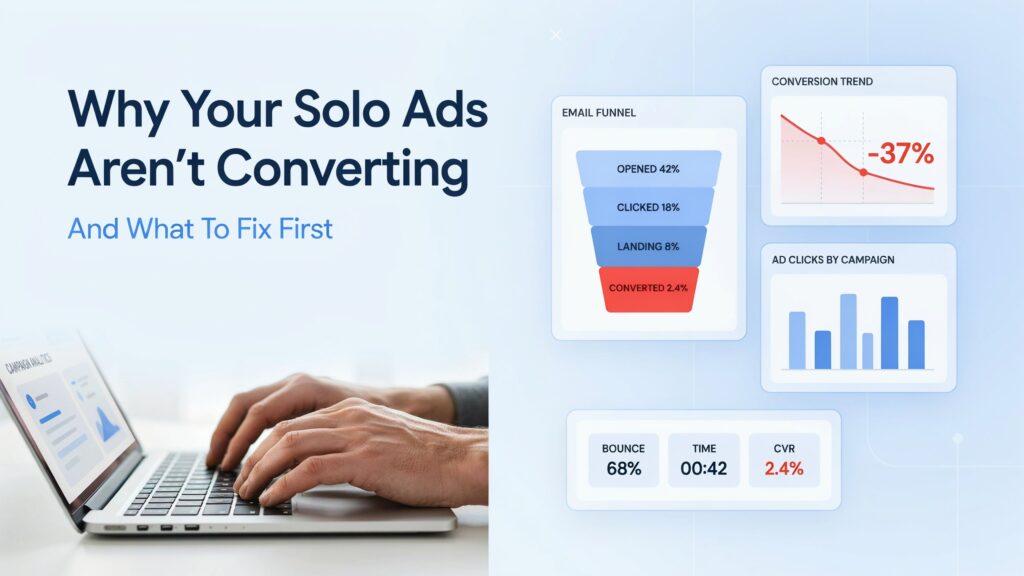
When solo ads not converting, avoid immediately blaming the vendor. First, separate the campaign into measurable stages: delivered clicks, landing-page visits, opt-ins, sales, and revenue. This tells you where the funnel is losing people.
For example, imagine you purchase 500 clicks. If only 40 people opt in, your landing page may be the bottleneck. If 200 people opt in but nobody buys, the problem is more likely your offer, sales page, email sequence, or audience alignment.
Create a simple performance snapshot:
- Clicks received
- Landing-page conversion rate
- Cost per lead
- Email open and click rates
- Sales generated
- Revenue per campaign
- Return on ad spend
This approach prevents emotional decisions. If solo ads not converting is a recurring issue, compare several campaigns instead of judging the entire channel from one result.
Why Solo Ads Not Converting Can Start With the Wrong Audience
Traffic quality and audience fit matter as much as click volume. You can receive hundreds of visitors and still get weak results if those visitors have little interest in your specific offer.
Suppose you sell an advanced email marketing course. A broad audience interested in making money online may generate clicks, but subscribers who specifically want email marketing strategies are more likely to engage and purchase.
When solo ads not converting, ask whether the vendor’s audience matches your niche, offer, and buyer intent. Request information about the audience’s interests, typical traffic sources, and previous campaign performance where available.
Do not choose a vendor solely because they promise a large number of clicks. A smaller, relevant audience can be more valuable than a large list with weak alignment.
Example: Vendor A offers 1,000 clicks for a low price, while Vendor B offers 600 clicks to an audience closely related to your niche. If Vendor B produces more qualified leads and sales, the cheaper traffic was not actually the better investment.
Fix the Landing Page When Solo Ads Not Converting
Your landing page is where paid attention becomes a lead. If visitors do not immediately understand what you offer or why they should care, your campaign can lose momentum within seconds.
When solo ads not converting, review the page from the visitor’s perspective. Does the headline match the promise that attracted them? Is the main benefit obvious? Is the call to action easy to find? Does the page load quickly on mobile?
For example, an ad that promises “5 proven email subject-line formulas” should lead to a page that clearly delivers on that promise. Sending those visitors to a generic homepage creates friction and can reduce conversions.
A strong landing page usually includes:
- A specific headline
- One clear value proposition
- Supporting benefits or proof
- A visible call to action
- Minimal distractions
- Mobile-friendly design
- Trust-building elements
Also test one major change at a time. Changing the headline, form, colors, offer, and layout simultaneously makes it difficult to identify what actually improved performance.
Make Sure Your Offer Matches the Traffic
Even a strong traffic source cannot rescue an offer that feels irrelevant, confusing, or too difficult to understand. Your offer should solve a clear problem and make the next step feel logical.
Consider two offers for the same audience. One says, “Join my digital marketing program.” The other says, “Get the 7-Day Email Funnel Starter Kit and build your first automated sequence.” The second offer gives visitors a clearer reason to act.
If solo ads not converting, examine the connection between the advertisement, landing page, lead magnet, and paid offer. Each step should continue the same message rather than introducing a completely different promise.
Pricing can also affect performance. A low-cost entry offer may convert more easily with cold traffic, while a high-ticket product may require stronger trust and a longer nurture sequence.
The goal is not always to make the offer cheaper. It is to make the value easier to understand and the buying decision easier to justify.
Strengthen Your Email Follow-Up
A new subscriber is not automatically a ready-to-buy customer. Many visitors need education, proof, reminders, and multiple touchpoints before they make a purchase.
When solo ads not converting, check what happens after the opt-in. Does the subscriber receive the promised lead magnet immediately? Is there a welcome email? Are subsequent emails useful and relevant? Is there a clear path from free value to your paid offer?
For example, a simple sequence might look like:
- Deliver the promised resource.
- Introduce the problem and explain why it matters.
- Share a useful strategy or case example.
- Address a common objection.
- Present the paid solution with a clear call to action.
- Follow up with another helpful insight and reminder.
Avoid sending sales messages repeatedly without providing value. Good follow-up builds familiarity and helps subscribers understand why your solution is worth considering.
What to Do When Solo Ads Not Converting: Test One Variable at a Time
Random changes make optimization difficult. Instead, treat each campaign as a controlled learning opportunity.
If solo ads not converting, test variables such as the vendor, landing-page headline, lead magnet, call to action, offer, email subject lines, and follow-up sequence. Keep the testing process organized so you can connect a change with a result.
For example, suppose your landing page receives 300 visitors and converts 12% of them. You create a second version with a clearer benefit-focused headline and test it against the original. If the new version reaches 18% under comparable traffic conditions, you have useful evidence that the messaging deserves further testing.
Keep records for every campaign:
- Vendor and traffic source
- Number of clicks
- Opt-ins
- Conversion rate
- Sales
- Revenue
- Cost
- Major changes made
The goal is not to find a perfect campaign instantly. The goal is to discover which combinations of traffic, messaging, offer, and follow-up consistently produce better results.
Improve Tracking Before You Scale
Scaling a campaign before you understand its economics can turn a small problem into an expensive one. Tracking gives you the evidence needed to decide whether to continue, optimize, or stop.
When solo ads not converting, verify that your analytics and conversion tracking are working correctly. Your tracking should distinguish traffic sources and, where possible, connect clicks to opt-ins and sales.
Use unique tracking links or campaign identifiers for different vendors. This lets you compare performance instead of combining every visitor into one large data set.
For example, Vendor A might deliver a 35% opt-in rate and Vendor B a 20% rate. But if Vendor B’s subscribers generate twice as many sales, the opt-in rate alone does not tell the complete story.
Before scaling, look at the full customer journey:
Traffic → Landing Page → Opt-In → Follow-Up → Sale → Revenue
This helps you optimize for business outcomes rather than vanity metrics such as clicks alone. If solo ads not converting after proper tracking, you can identify the weakest stage and address it directly.
Conclusion: Turn More Clicks Into Customers
Poor campaign performance does not automatically mean the traffic source is ineffective. In many cases, the real problem is a disconnect between the audience, message, landing page, offer, follow-up, and tracking.
If solo ads not converting, start with the data instead of making assumptions. Identify where prospects leave your funnel, fix the weakest stage, and then test the results. If solo ads not converting continues to be an issue, review your targeting and traffic quality before increasing your budget.
The most successful advertisers treat every campaign as a learning opportunity. By improving audience alignment, creating stronger landing pages, developing relevant offers, strengthening follow-up, and tracking meaningful metrics, you can build a more predictable customer acquisition system.
Frequently Asked Questions?
How do I know whether my traffic quality is good?
Look beyond the number of clicks. Review opt-in rates, engagement, email activity, sales, and revenue generated by each traffic source. Quality traffic should produce visitors who are genuinely interested in your offer.
What is a good landing-page conversion rate?
There is no universal number because conversion rates vary by niche, offer, audience, traffic temperature, and page design. Instead of relying on a single benchmark, establish your current rate and continuously test improvements.
Should I change my landing page or offer first?
Look at your funnel data. If visitors leave without opting in, test the landing page and messaging first. If many visitors become leads but few purchase, investigate the offer, sales page, pricing, and follow-up process.
How long should I wait before judging a campaign?
Give the campaign enough traffic to produce meaningful data. A decision based on a handful of clicks can be misleading. Compare campaigns using consistent metrics and similar traffic volumes whenever possible.
Should I buy more clicks if my campaign performs poorly?
Not immediately. First identify the bottleneck. More traffic will not solve a landing page, offer, targeting, or follow-up problem. Fix the weakest part of the funnel before increasing your budget.