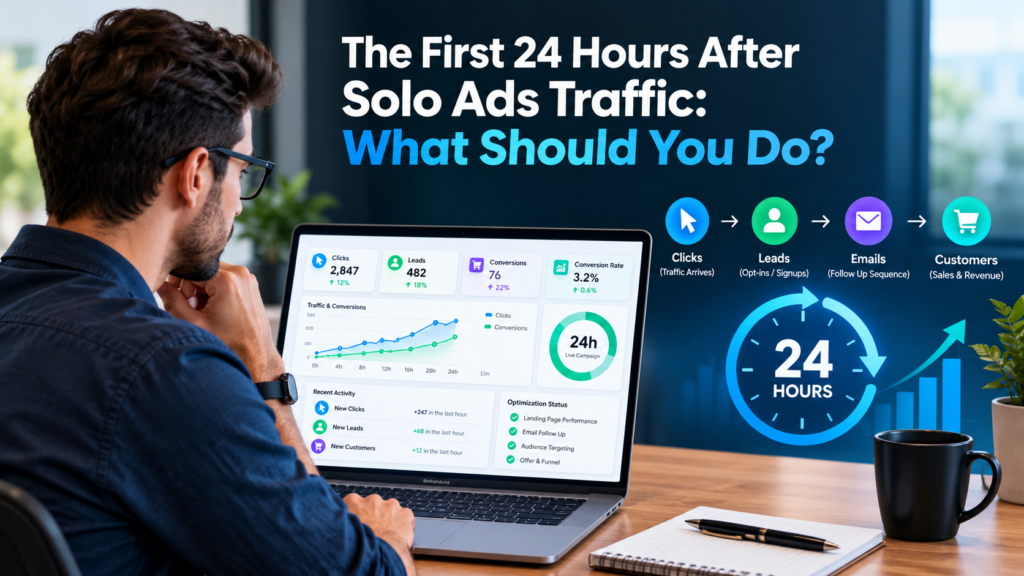
Getting solo ads traffic to your website is only the beginning. The first 24 hours after your campaign starts can provide valuable information about traffic quality, landing-page performance, lead generation, and potential problems.
Many marketers make the mistake of simply watching their click counter and waiting for results. A better approach is to actively monitor what happens after visitors arrive.
Are people clicking your call to action? Are they joining your email list? Is your landing page converting? Are the leads engaging with your follow-up emails?
The answers can help you decide whether to continue, adjust, or scale your campaign.
Here is what you should do during those crucial first 24 hours.
Table of Contents
Confirm That Your Tracking Is Working
The first thing to check when solo ads traffic starts arriving is whether your tracking system is recording everything correctly.
Before the campaign begins, make sure your tracking links, analytics, conversion tracking, and opt-in forms are working.
You should be able to monitor the basic journey:
Click → Landing Page Visit → Opt-In → Follow-Up → Sale
Run through the process yourself before judging the campaign.
Click your tracking link and check whether the visitor is recorded correctly. Submit your own form and confirm that the lead enters your email system. Check whether the thank-you page loads correctly.
Also verify that your campaign parameters are being recorded properly.
If tracking is broken, you could spend money on traffic without knowing what it actually produces.
For example, imagine your campaign generates 300 visitors but your analytics platform records only 180. You may incorrectly conclude that the campaign is underperforming.
Fix tracking problems before making optimization decisions.
Watch Your Solo Ads Traffic Quality Closely
Once visitors begin arriving, pay attention to the quality of the traffic rather than focusing only on volume.
Your solo ads traffic should come from people who have a reasonable connection to your niche and offer.
Look at metrics such as:
- Number of visitors
- Time on page
- Pages viewed
- Bounce rate
- Opt-in rate
- Geographic information where relevant
- Traffic behavior
- Conversion activity
For example, suppose you receive 200 visitors but almost everyone leaves immediately without interacting with your page.
That could indicate a mismatch between your advertisement and landing page, weak targeting, or traffic that isn’t interested in your offer.
On the other hand, visitors who spend time reading your content and completing your opt-in form are showing stronger engagement.
Don’t judge traffic quality from one metric alone.
Look at the overall behavior.
You can also compare the incoming traffic with your campaign expectations and previous tests to determine whether the audience appears relevant.
Check Your Landing Page Conversion Rate
Your landing page is the bridge between traffic and leads.
If solo ads traffic is arriving but very few visitors are opting in, don’t immediately blame the traffic source.
Your landing page could be the problem.
Check whether your page has:
- A clear headline
- A strong value proposition
- One primary call to action
- A simple opt-in form
- Relevant content
- Mobile-friendly design
- Fast loading speed
- Trust signals
For example, suppose 500 visitors reach your page and only 10 submit the form.
That’s a 2% conversion rate.
Before purchasing more traffic, investigate why visitors aren’t taking action.
Your headline might be unclear. Your offer might not be compelling enough. Your form may ask for too much information. Or the page may not match the message that attracted visitors in the first place.
The first 24 hours give you an opportunity to identify these issues before they become expensive problems.
Monitor Your Lead Generation and Email Engagement
Clicks are useful, but leads are much more valuable.
When solo ads traffic starts generating subscribers, monitor what those new leads do next.
Check:
- Number of new subscribers
- Opt-in conversion rate
- Email delivery
- Open rates
- Click-through rates
- Unsubscribe activity
- Responses or other engagement
For example, imagine you receive 100 new subscribers from your campaign.
If your emails are being delivered successfully and subscribers are opening and clicking your messages, that gives you useful evidence that the audience may be relevant.
However, if you see unusually high unsubscribe rates or almost no engagement, investigate further.
Your lead magnet and email messaging should also match the promise made in the advertisement.
If someone clicked because they expected a free SEO checklist but immediately receives unrelated promotional content, they may lose interest quickly.
Your first 24 hours are an opportunity to identify these disconnects.
Review Your Solo Ads Traffic Against Your Goals
Don’t evaluate a campaign without knowing what success means.
Before launching your campaign, establish realistic performance targets.
For example:
Traffic goal: 500 clicks
Lead goal: 100 subscribers
Target opt-in rate: 20%
Sales goal: 10 customers
Target revenue: $500
Once your campaign begins, compare actual results with these benchmarks.
Suppose you receive 500 clicks but only 25 leads.
The problem isn’t necessarily the traffic volume. Your landing page may simply be converting poorly.
Alternatively, suppose you generate 100 leads but no sales.
That could indicate a problem with your offer, email follow-up, sales page, or customer targeting.
This is why you should evaluate solo ads traffic against the complete customer journey rather than focusing on clicks alone.
Your goal is not to collect visitors.
Your goal is to generate measurable business results.
Identify Problems Before You Scale
The first 24 hours are not necessarily the time to increase your budget.
They are often the time to identify potential problems.
Look for warning signs such as:
- High traffic but very few opt-ins
- Large numbers of visitors leaving immediately
- Poor email engagement
- Broken tracking
- Low-quality leads
- Unexpected traffic patterns
- High unsubscribe rates
- No movement toward sales
Suppose your campaign produces 250 clicks but only five subscribers.
Buying another 1,000 clicks before fixing the landing page could simply multiply the problem.
Instead, pause and investigate.
Test your headline, offer, CTA, page layout, or traffic targeting.
If the issue appears to be traffic-related, discuss the campaign with your vendor and provide the relevant data.
The goal is to solve the bottleneck before scaling.
Measure Results and Decide Your Next Step
After 24 hours, gather your data and determine what you have learned.
Your report might look something like this:
Clicks: 500
Leads: 100
Opt-in rate: 20%
Sales: 8
Revenue: $400
Traffic cost: $150
Now you have enough information to start evaluating the campaign.
You can ask:
- Is the traffic generating relevant leads?
- Is the landing page converting?
- Are subscribers engaging?
- Are sales being generated?
- Is the campaign profitable?
- What should be improved before the next test?
If the numbers are promising, you can continue collecting data and potentially increase your volume gradually.
If the results are weak, identify the exact stage causing the problem.
Solo Ad Hub also provides guidance on measuring solo ads campaign success, which can help you evaluate performance beyond basic click numbers.
The important point is to make your next decision based on data rather than assumptions.
Conclusion
The first 24 hours after launching a campaign should not be treated as a waiting period.
It is an opportunity to understand how your solo ads traffic behaves and whether your funnel is working as expected.
Start by confirming your tracking. Then monitor traffic quality, check your landing-page conversion rate, review lead and email engagement, compare results against your goals, identify problems, and decide what to do next.
Remember that clicks are only the beginning.
The real value comes from what happens after the click.
If your visitors become leads, engage with your emails, and eventually become customers, your campaign has the potential to generate meaningful ROI.
Monitor the data carefully, fix problems early, and scale only after the numbers justify it. 📊
Frequently Asked Questions
What should I check immediately after launching a campaign?
Check that your tracking links, landing page, forms, analytics, and email automation are working correctly. Then monitor incoming visitors and conversions.
How quickly can I judge traffic quality?
You can identify early warning signs within the first day, but a reliable assessment usually requires enough data to account for normal campaign variation.
What if I receive clicks but no leads?
Check your landing page, offer, CTA, form, and message match before assuming the traffic source is the problem.
Should I scale my campaign after the first day?
Not automatically. Use the initial data to identify potential problems, but collect enough performance information before making major budget increases.
Which metric matters most during the first 24 hours?
There isn’t one universal metric. Look at the relationship between clicks, opt-ins, conversion rate, engagement, sales, and cost to understand the complete campaign.