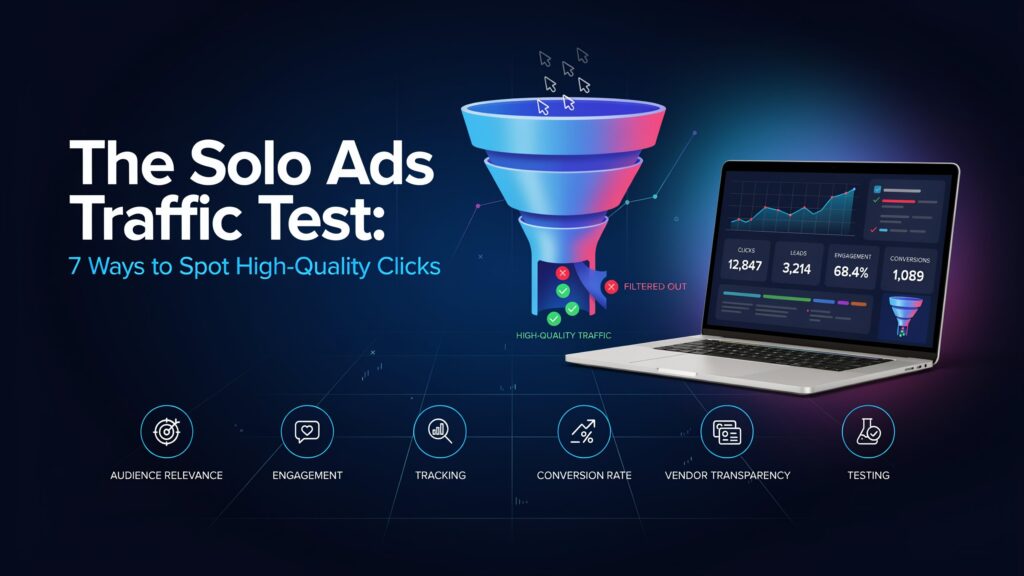
Getting clicks is easy to measure, but knowing whether those clicks are valuable is much more important. Solo ads traffic quality can determine whether your campaign generates engaged visitors, leads, and customers—or simply produces impressive numbers with little business value.
Not every click represents the same level of interest. Some visitors may be genuinely interested in your niche, while others may click out of curiosity and leave immediately. This is why marketers need to look beyond click volume when evaluating a solo ad campaign.
In this guide, you’ll discover 7 practical ways to evaluate solo ads traffic quality, identify potential problems, and make smarter decisions before increasing your advertising budget.
Table of Contents
Look Beyond the Number of Clicks
The first mistake marketers make is assuming that a large number of clicks automatically means they received good traffic.
Clicks are important, but they are only the beginning of the customer journey. A campaign generating 1,000 clicks can be less valuable than one generating 500 clicks if the smaller campaign produces more qualified leads and sales.
When evaluating solo ads traffic quality, consider what happens after visitors click.
Look at metrics such as:
- Landing-page visits
- Opt-in rate
- Email engagement
- Sales
- Cost per lead
- Cost per customer
- Revenue generated
- Return on investment
For example, imagine two campaigns:
Campaign A:
- 1,000 clicks
- 70 leads
- 2 sales
Campaign B:
- 600 clicks
- 120 leads
- 10 sales
Campaign A produced more clicks, but Campaign B clearly delivered more useful traffic.
This is why you should never judge a vendor solely by the number of clicks they promise. The real question is whether those visitors take meaningful actions after arriving.
A good traffic source should help move prospects further through your funnel—not simply increase the number on your analytics dashboard.
Solo Ads Traffic Quality Starts With Audience Relevance
One of the strongest indicators of solo ads traffic quality is whether the audience actually matches your niche and offer.
A highly engaged audience can still perform poorly if its interests do not align with what you are selling.
For example, suppose you are promoting an advanced affiliate marketing course. Sending your advertisement to people interested specifically in affiliate marketing makes more sense than sending it to a completely unrelated audience simply because the list is large.
Before purchasing traffic, ask the vendor:
- What niche does the audience follow?
- Where did the subscribers come from?
- What types of offers typically perform well?
- How engaged is the list?
- How frequently are subscribers contacted?
- What countries or regions are represented?
Audience relevance matters because people are more likely to respond when the message matches their existing interests.
This principle also applies to your email creative. A message designed for experienced marketers should not assume that every reader is a complete beginner.
You can improve your targeting by matching three things:
Audience + Problem + Offer
When all three align, visitors are more likely to understand your message and continue through the funnel.
Test Solo Ads Traffic Quality With Engagement Data
Another important way to evaluate solo ads traffic quality is to study engagement rather than focusing only on delivery numbers.
A vendor may successfully deliver the number of clicks you purchased. However, that does not tell you whether the visitors are genuinely interested in your business.
Watch what happens after people reach your website.
Do they:
- Read your content?
- Complete your opt-in form?
- Visit additional pages?
- Open your follow-up emails?
- Click links in those emails?
- Return to your website?
- Purchase your product?
These behaviors provide much more useful information than raw click volume.
For example, imagine you purchase 500 clicks and receive 150 new subscribers. At first, that might look excellent. But if almost none of those subscribers engage with your emails, the initial numbers may be misleading.
Your goal should be to identify traffic that continues to interact with your business after the first click.
This is also where audience segmentation can become useful. If subscribers are grouped according to their interests and behavior, you can create more relevant follow-up messages and better understand which visitors are genuinely engaged.
Tracking engagement over time gives you a clearer picture of solo ads traffic quality than simply counting clicks.
Check Whether the Traffic Matches Your Offer
Even excellent traffic can perform poorly when the offer is not appropriate for the audience.
This is one of the easiest factors to overlook when evaluating solo ads traffic quality.
Consider a vendor whose audience is primarily interested in low-cost digital products. If you immediately promote a $2,000 coaching program without a strong trust-building funnel, the campaign may struggle even if the audience is real and engaged.
The problem is not necessarily the traffic.
The problem could be the gap between the audience’s expectations and your offer.
Before buying a campaign, ask:
Does this audience have a reason to want my product?
Then consider:
- Product price
- Audience experience level
- Problem urgency
- Buying intent
- Offer complexity
- Required level of trust
A simple lead magnet can often work well as the first step because it gives visitors an easy way to engage without asking them to make a large purchase immediately.
For example:
Solo ad → Free guide → Email sequence → Product offer
This approach gives you an opportunity to educate visitors and build trust before presenting a more expensive product.
Examine the Vendor’s Transparency
Vendor transparency can provide valuable clues about solo ads traffic quality before you spend your budget.
A professional vendor should be able to clearly explain what you are purchasing and what you can realistically expect.
Before placing an order, look for information about:
- Traffic type
- Audience niche
- Delivery process
- Geographic targeting
- Tracking
- Click verification
- Replacement policies
- Previous customer experiences
Be cautious when a vendor focuses almost entirely on extremely cheap clicks or guarantees unrealistic results.
For example, a promise such as “1,000 clicks guaranteed to produce sales” should immediately raise questions. Traffic can be delivered, but sales depend on many variables, including the offer, landing page, funnel, pricing, and follow-up.
A better approach is to ask the vendor questions about the traffic itself.
You can also start with a smaller test rather than committing a large budget immediately.
A controlled test gives you the opportunity to evaluate actual performance before scaling.
You can also review how a provider approaches traffic testing. For example, Solo Ad Hub explains its own process for checking email-list quality, engagement, click behavior, and campaign compatibility before sending traffic. Learn how solo ad traffic is tested before delivery.
Use Tracking to Measure Solo Ads Traffic Quality
Without accurate tracking, evaluating solo ads traffic quality becomes much more difficult.
You need to know exactly where your visitors came from and what they did after clicking.
Use separate tracking links for different vendors and campaigns whenever possible.
For example:
Vendor A → Campaign A → Landing Page A
Vendor B → Campaign B → Landing Page B
This allows you to compare results more accurately.
Track important metrics such as:
- Clicks
- Unique visitors
- Opt-ins
- Conversion rate
- Email engagement
- Sales
- Cost per lead
- Cost per customer
- Revenue
- ROI
Using UTM parameters can also make campaign attribution easier. Google Analytics explains how UTM parameters can identify the campaigns that send traffic to your website.
Suppose Vendor A delivers 500 clicks and Vendor B delivers 400. At first glance, Vendor A appears better.
But after tracking, you discover:
Vendor A: 500 clicks → 50 leads → 2 sales
Vendor B: 400 clicks → 100 leads → 8 sales
Vendor B delivered fewer visitors but significantly stronger business results.
That is why tracking should be connected to your complete funnel rather than stopping at the click.
Accurate data helps you understand solo ads traffic quality and determine which sources deserve more of your budget.
Run a Small Test Before You Scale
One of the safest ways to evaluate solo ads traffic quality is to start with a controlled test.
Instead of immediately purchasing thousands of clicks, begin with a smaller campaign that gives you enough data to identify potential problems.
For example, you might test:
- One vendor
- One offer
- One landing page
- One email creative
- One tracking link
- A controlled click volume
Then analyze the results.
If the campaign performs well, you can gradually increase your traffic volume.
If performance is weak, investigate the bottleneck before spending more money.
This approach prevents a common mistake: scaling a campaign before knowing whether it actually works.
Suppose your first test generates a strong opt-in rate but weak sales. More traffic will not necessarily solve the problem. Your offer or follow-up may need improvement.
On the other hand, if your landing page performs well but traffic produces unusually low engagement, you may need to investigate the vendor or audience.
Testing gives you information before you commit a larger budget.
The objective is not to find a vendor that simply delivers the most clicks. It is to identify a traffic source that consistently produces meaningful actions throughout your funnel.
Conclusion
Solo ads traffic quality should always be evaluated based on what happens after the click—not simply how many visitors arrive.
Start by checking audience relevance, engagement, offer alignment, vendor transparency, tracking, and actual conversion data. Then run controlled tests before increasing your budget.
Remember that more clicks do not automatically mean better results. A smaller number of highly relevant visitors can be considerably more valuable than thousands of uninterested clicks.
When you combine careful vendor selection with accurate tracking and systematic testing, you can make smarter decisions about your solo ad campaigns and reduce wasted advertising spend.
The goal is simple: find traffic that does more than click. Find traffic that engages, converts, and contributes to profitable growth.
FAQs
What makes solo ad traffic high quality?
High-quality traffic generally comes from real, relevant, and engaged people who have an interest in the topic or problem connected to your offer. Engagement and downstream actions are more important than raw click volume.
How can I tell if a solo ads vendor is reliable?
Look for clear communication, relevant audience information, transparent tracking, realistic expectations, and evidence of previous customer experiences. Starting with a smaller test can also reduce your risk.
Should I choose the vendor offering the cheapest clicks?
Not necessarily. The cheapest traffic can become expensive if it produces very few leads or customers. Compare vendors using metrics such as cost per lead, conversion rate, sales, and ROI.
How many clicks should I test before scaling?
There is no universal number because results vary by niche, offer, funnel, and audience. The important thing is to collect enough data to identify a reliable performance pattern before significantly increasing your budget.
What metrics should I track during a solo ad campaign?
Track clicks, unique visitors, opt-ins, conversion rate, email engagement, sales, cost per lead, cost per customer, revenue, and ROI.