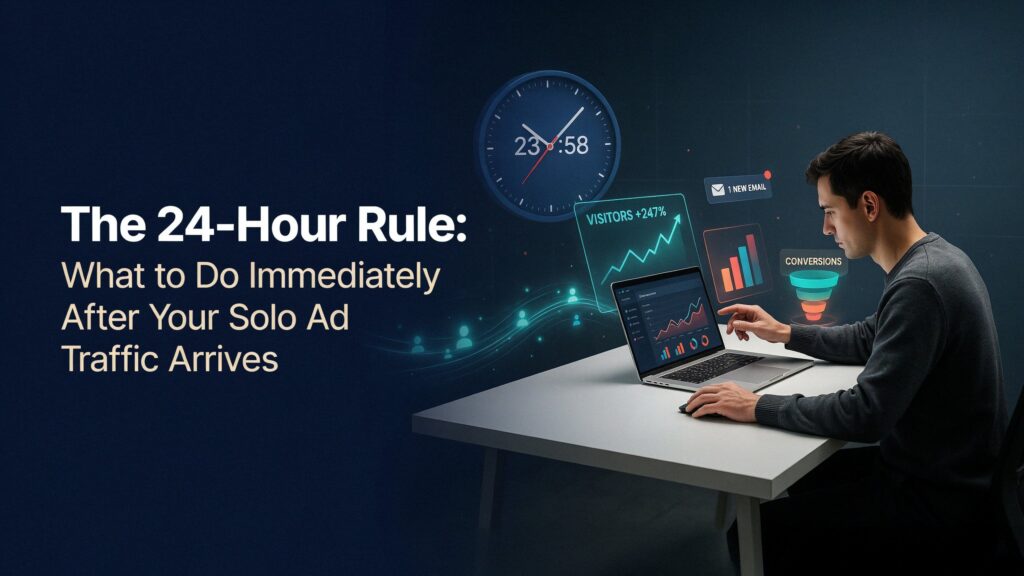
Buying a solo ad is only the beginning of your campaign. What you do immediately after solo ads traffic starts arriving can have a major impact on your opt-ins, conversions, and long-term results.
Many marketers make the mistake of launching a campaign, watching the clicks come in, and waiting until the campaign ends before reviewing the data. The first 24 hours are often the best time to monitor performance, identify problems, and make sure your funnel is working as expected.
This guide explains exactly what to focus on after your campaign goes live.
Table of Contents
Confirm That Every Part of Your Funnel Is Working
The first thing you should do is test your entire conversion process.
Do not assume that everything is working correctly simply because you tested the page before launching. Technical problems can happen at any stage, and even a small issue can cost you valuable leads.
Go through the same journey your visitors will experience:
- Click the campaign link.
- Open the landing page.
- Check the page on both desktop and mobile.
- Submit the opt-in form.
- Confirm that the subscriber reaches the correct thank-you page.
- Check whether the lead appears inside your email marketing platform.
- Verify that the first automated email is delivered.
For example, imagine you receive 100 clicks during the first few hours. Your landing page appears to work, but your email integration has stopped sending new leads to your list.
If you do not discover the problem until the next day, those visitors may already be gone.
Before analyzing conversion rates, make sure the system itself is functioning correctly.
Track Your Solo Ads Traffic From the Start
Once your funnel is confirmed, start monitoring where your visitors are going and what actions they are taking.
Good solo ads traffic tracking should help you answer questions such as:
- How many clicks have arrived?
- How many visitors reached the landing page?
- How many people opted in?
- What is the current conversion rate?
- Are visitors coming from the expected campaign link?
- Are there unusual patterns in the data?
Use tracking links or UTM parameters to separate this campaign from your other marketing efforts.
For example, if you are running multiple campaigns at the same time, create unique tracking parameters for each source. This allows you to see which campaign generated each visit and prevents your data from becoming mixed together.
You should also pay attention to timing. If your campaign is expected to deliver traffic gradually over several days, do not panic after the first few hours because the numbers may not yet represent the final result.
The goal is to observe the campaign carefully without making decisions based on incomplete data.
Measure How Solo Ads Traffic Is Converting
Clicks alone do not tell you whether a campaign is successful.
You need to understand what happens after visitors arrive.
One of the simplest metrics to monitor is your opt-in conversion rate:
Opt-in Rate = Number of Opt-Ins ÷ Number of Unique Visitors × 100
For example, if 200 visitors arrive and 60 subscribe:
60 ÷ 200 × 100 = 30% opt-in rate
This immediately gives you more useful information than simply knowing that you received 200 clicks.
When reviewing solo ads traffic, look at the relationship between:
- Delivered clicks
- Unique visitors
- Landing page views
- Opt-ins
- Email confirmations, if applicable
- Initial sales or conversions
A campaign can generate a large number of clicks but still perform poorly if visitors are not taking the action you want.
On the other hand, a smaller campaign may be more valuable if the visitors are highly relevant and convert at a stronger rate.
The key is to measure the entire journey rather than focusing only on the top-level traffic number.
Check Your Landing Page for Early Warning Signs
The first few hours can reveal whether your landing page is creating unnecessary friction.
Pay attention to signs such as:
- A large number of visitors but very few opt-ins
- High bounce rates
- Short time spent on the page
- Mobile visitors leaving faster than desktop visitors
- Form submissions failing
- Slow loading times
For example, suppose your campaign sends 150 visitors to your page, but only five people subscribe.
Before blaming the traffic source, investigate the landing page.
Your headline may be unclear. The offer may not match the message that encouraged the visitor to click. The page could be loading slowly on mobile devices.
A simple test is to view the page as a new visitor. Ask yourself:
Can someone understand the offer within five seconds?
If the answer is no, simplify the page.
Use one clear headline, explain the main benefit, remove unnecessary distractions, and give visitors a simple next step.
Watch the Quality of Your New Leads
Getting subscribers is important, but quantity should not be the only measurement.
After your first batch of leads arrives, look for early signs of quality.
For example:
- Are subscribers opening your first email?
- Are they clicking links inside your emails?
- Are they confirming their subscriptions?
- Are email addresses valid?
- Are there unusual patterns or duplicate entries?
If you receive 100 new subscribers but almost nobody opens your welcome email, you may have a targeting problem, an inbox placement issue, or a mismatch between the campaign promise and your follow-up content.
A healthy campaign should bring people who are genuinely interested in the topic or offer.
When evaluating solo ads traffic, think beyond the initial opt-in. The real value of a lead becomes clearer when you see how that person interacts with your emails and future offers.
Follow Up With Solo Ads Traffic Immediately
The first interaction after someone subscribes is critical.
Do not wait several days before contacting new leads. Your visitors are most aware of your brand immediately after they opt in.
A simple follow-up sequence could look like this:
Email 1: Deliver What You Promised
Send the lead magnet, guide, video, or resource immediately.
If someone subscribed to receive a checklist, make it easy to access without forcing them to search through multiple emails.
Email 2: Provide Additional Value
A few hours or a day later, share a useful tip, example, or insight related to the original offer.
For example:
“Yesterday, you downloaded the campaign checklist. Here is one mistake that can waste paid traffic before your first visitor even arrives.”
Email 3: Introduce the Next Step
Once you have delivered value, you can introduce a relevant product, service, or resource.
The purpose is not to overwhelm new subscribers with aggressive sales messages. It is to build a logical relationship between the reason they subscribed and the next action you want them to take.
Fast and relevant follow-up can help you get more value from the leads generated by solo ads traffic.
Record the Results Before Making Major Changes
The first 24 hours should be used for monitoring and identifying obvious problems—not constantly changing everything.
If you change your headline, offer, landing page, and email sequence at the same time, you will not know which change affected the results.
Create a simple campaign record that includes:
- Date and time the campaign started
- Number of purchased clicks
- Number of visitors delivered
- Number of opt-ins
- Conversion rate
- Cost per lead
- Initial email engagement
- Sales or other conversions
For example:
| Metric | Campaign Result |
|---|---|
| Purchased Clicks | 300 |
| Unique Visitors | 285 |
| Opt-Ins | 72 |
| Conversion Rate | 25.3% |
| Cost Per Lead | $1.25 |
This information becomes valuable when you run future campaigns.
Over time, you can compare different traffic sources, landing pages, offers, and follow-up sequences.
Instead of relying on assumptions, you can use actual campaign data to decide what should be improved next.
Conclusion
The first 24 hours after launching a campaign should not be treated as a waiting period. It is the time to verify your funnel, monitor results, check lead quality, and ensure your follow-up system is working.
The most effective approach to solo ads traffic is to look beyond the number of clicks. Track what happens after the visitor arrives, measure conversions, and identify any technical or messaging problems early.
By following the 24-hour rule, you can catch costly issues before they affect the entire campaign and collect useful data for improving future results. The goal is not simply to receive visitors—it is to turn the right visitors into valuable leads and customers.
Frequently Asked Questions
How soon should I check my campaign results?
You should check early enough to identify technical problems, broken forms, or tracking issues. However, avoid making major decisions based on only a small amount of data.
What is the first metric I should monitor?
Start by confirming that visitors are reaching your landing page and that your desired conversion action, such as an opt-in or purchase, is being recorded correctly.
Should I change my landing page immediately if conversions are low?
First check for obvious problems such as broken forms, slow loading speeds, message mismatch, or poor mobile usability. If the campaign has only delivered a small amount of data, wait before making major conclusions.
How important is the first follow-up email?
It is extremely important because it delivers the promise that encouraged the person to subscribe and establishes the first impression of your brand.
Should I track every campaign separately?
Yes. Using separate tracking links or UTM parameters can make it easier to identify which campaigns, offers, and sources are producing the best results.