Paid traffic and email marketing can both help businesses generate leads, but they work in very different ways. Understanding solo ads vs email marketing is important if you are deciding where to invest your marketing budget.
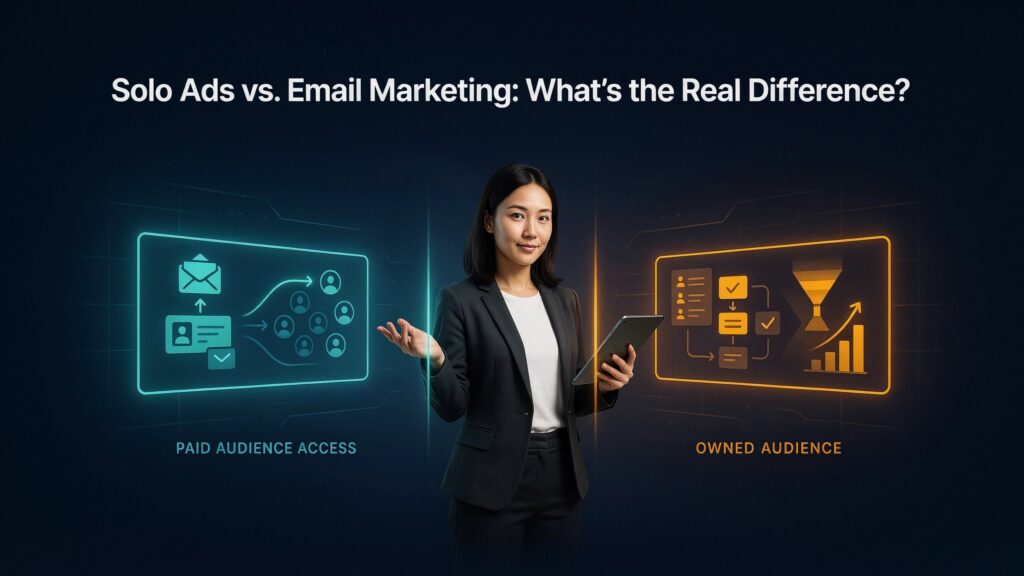
Solo ads give you access to another person’s established email audience, while email marketing allows you to communicate directly with your own subscribers. One can help you acquire an audience faster; the other gives you greater control over long-term relationships.
In this guide, we’ll compare the two approaches across seven important areas, including cost, audience ownership, targeting, conversions, scalability, and long-term value.
Table of Contents
How Solo Ads and Email Marketing Actually Work
The first step in understanding solo ads vs email marketing is knowing how each model works.
With solo ads, you pay a provider or email list owner to send a promotional message to their subscribers. You typically pay based on the number of clicks or another agreed campaign metric.
The basic process looks like this:
Provider’s email list → Promotional email → Your landing page → Lead capture → Follow-up
For example, an affiliate marketer could pay for targeted traffic from an audience interested in online business. The promotional email directs subscribers to a free guide, where they can enter their email address.
Email marketing works differently.
Instead of relying on someone else’s list, you communicate with subscribers you have already captured through your own website, lead magnet, webinar, checkout process, or other acquisition channel.
A typical email marketing funnel might look like:
Traffic source → Opt-in page → Your email list → Email sequence → Offer → Customer
The biggest difference is ownership. With paid list traffic, you are accessing someone else’s audience. With your own email marketing, you control the relationship with your subscribers.
Solo Ads vs Email Marketing: Audience Ownership
One of the biggest differences in solo ads vs email marketing is who owns the audience.
When you purchase a solo ad campaign, you do not gain ownership of the provider’s subscribers. You are essentially renting access to their attention for a specific promotion.
This can be useful when you want to reach people quickly.
Imagine you have just launched a new digital product and have no significant email list. Building your own audience could take months. A relevant solo ad provider may allow you to reach an established audience much sooner.
However, the provider controls the relationship with those subscribers.
With your own email list, you have much more control. You can send future campaigns, create automated sequences, segment subscribers, conduct surveys, promote new products, and continue communicating with your audience.
For example, suppose you spend $500 acquiring 100 new subscribers through paid traffic. Once those people join your list, you can potentially communicate with them repeatedly rather than paying for access to the same audience again.
This makes list building an important long-term asset.
The strongest strategy can therefore be to use paid traffic to build your own audience, then use email marketing to nurture and monetize that audience over time.
Solo Ads vs Email Marketing: Cost and Investment
When comparing solo ads vs email marketing, cost needs to be viewed beyond the initial price.
Solo ads generally involve an upfront advertising expense. You pay for traffic according to the provider’s pricing model and campaign terms.
For example:
- Campaign cost: $300
- Visitors: 600
- Leads: 60
- Cost per lead: $5
Your actual acquisition cost depends on how many visitors become subscribers and eventually customers.
Email marketing has a different cost structure. You may need an email marketing platform, automation tools, domain authentication, landing pages, and content. However, once subscribers are on your list, sending additional emails can be relatively inexpensive compared with repeatedly purchasing new traffic.
Consider a business with 5,000 subscribers.
The business can potentially send a promotional email to those subscribers without paying for 5,000 new visitors each time.
This creates an important distinction:
Solo ads are primarily an audience acquisition expense.
Email marketing is primarily an audience relationship and monetization channel.
A smart marketer should measure the lifetime value of subscribers rather than judging either strategy solely by its immediate cost.
Which Strategy Gives You More Control?
Control is another major factor when evaluating solo ads vs email marketing.
With solo ads, you depend on the provider for several important elements:
- Audience quality
- Subscriber engagement
- Email delivery
- Traffic volume
- Campaign timing
- List relevance
You can control your offer, landing page, and follow-up, but you cannot directly control the provider’s audience.
Email marketing gives you substantially more control over your communication.
Once someone joins your list, you can decide:
- What emails they receive
- How frequently you contact them
- Which segments receive specific offers
- What automated sequences they enter
- Which products you promote
- How you nurture them
- When you re-engage inactive subscribers
For example, you could divide your list into beginners, experienced customers, and existing buyers. Each segment can receive different content based on its interests and previous behavior.
That level of control is one of the strongest advantages of owning your own email audience.
Lead Generation and Conversion Potential
Another important difference in solo ads vs email marketing is where each strategy fits into the customer journey.
Solo ads are often used to generate new visitors and leads.
For example:
Paid email traffic → Free checklist → Email opt-in
The goal is to acquire a new subscriber.
Email marketing then helps convert and retain those subscribers.
You might send:
Welcome email → Educational content → Case study → Product recommendation → Follow-up
This means the two strategies do not necessarily need to compete with each other.
They can work together.
Imagine you spend $400 on a targeted campaign and acquire 80 subscribers. Those subscribers then enter a 10-day email sequence.
If the sequence generates several sales, the value of the original traffic becomes greater than the immediate opt-in.
This is why marketers should avoid evaluating paid traffic based only on the first transaction.
The real value may come from what happens after the visitor joins your list.
Solo Ads vs Email Marketing: Which Is Easier to Scale?
Scalability is another area where solo ads vs email marketing can look very different.
Solo ads can be scaled by purchasing more traffic, testing additional providers, or expanding into new relevant audiences.
However, scaling depends on the availability and quality of external lists.
If a particular provider delivers excellent results, you may eventually reach the limits of that audience. Buying more traffic may also cause performance to change as additional subscribers are exposed to your offer.
Email marketing can scale differently.
Suppose you build a list of 10,000 subscribers.
You can create automated campaigns that communicate with those subscribers repeatedly. You can also segment your audience and personalize messages based on subscriber behavior.
For example:
New subscriber: receives a welcome sequence.
Engaged subscriber: receives educational content and relevant offers.
Customer: receives product-related emails and cross-sell opportunities.
Inactive subscriber: receives a re-engagement campaign.
This makes email automation particularly valuable for businesses looking to create repeatable marketing systems.
Which Strategy Is Better for Your Business?
The final question in solo ads vs email marketing is not necessarily which strategy is universally better.
Instead, ask which role each one should play in your marketing funnel.
Solo ads can make sense when you:
- Need targeted traffic quickly
- Want to test an offer
- Are building an email list
- Have a clear lead magnet
- Want to reach an established niche audience
- Need another customer acquisition channel
Email marketing becomes especially valuable when you:
- Already have subscribers
- Want to nurture leads
- Sell products repeatedly
- Have an automated funnel
- Want greater control over communication
- Want to increase customer lifetime value
For example, an affiliate marketer could use solo ads to acquire 500 new subscribers and then use email marketing to educate those subscribers and recommend relevant products.
In that situation, the two strategies are complementary rather than competing.
The most effective approach may be to use paid traffic as the front end of the funnel and email marketing as the relationship and conversion engine.
Conclusion
ownership.
Solo ads can help you reach an established email audience quickly and generate new leads without waiting to build your own list. Email marketing gives you control over the subscribers you acquire and allows you to nurture those relationships repeatedly.
For many businesses, the best solution is not choosing one over the other.
Use targeted paid traffic to acquire relevant subscribers, then use your own email marketing system to educate, nurture, and convert them.
The key is to measure the entire funnel—from the initial click to the eventual customer and revenue generated.
When these two channels are combined strategically, paid traffic can help grow your audience while email marketing turns that audience into a long-term business asset.
Frequently Asked Questions
What are solo ads?
Solo ads are paid email promotions where a business pays an email list owner or traffic provider to send a promotional message to their subscribers.
Do I need an email list to use paid email traffic?
No. You can use paid email traffic to send visitors to a landing page and capture new subscribers. However, having a follow-up system ready is important.
Is email marketing free?
Email marketing usually has some operating costs, such as an email service provider and automation tools. However, sending additional messages to an existing list can be relatively inexpensive.
Which option is better for beginners?
It depends on the business. Beginners who need to acquire an audience may benefit from targeted paid traffic, while those who already have subscribers may get more value from developing their email campaigns.
Can paid traffic help grow an email list?
Yes. A well-targeted campaign can send relevant visitors to a lead magnet or opt-in page, allowing a business to turn paid traffic into owned subscribers.