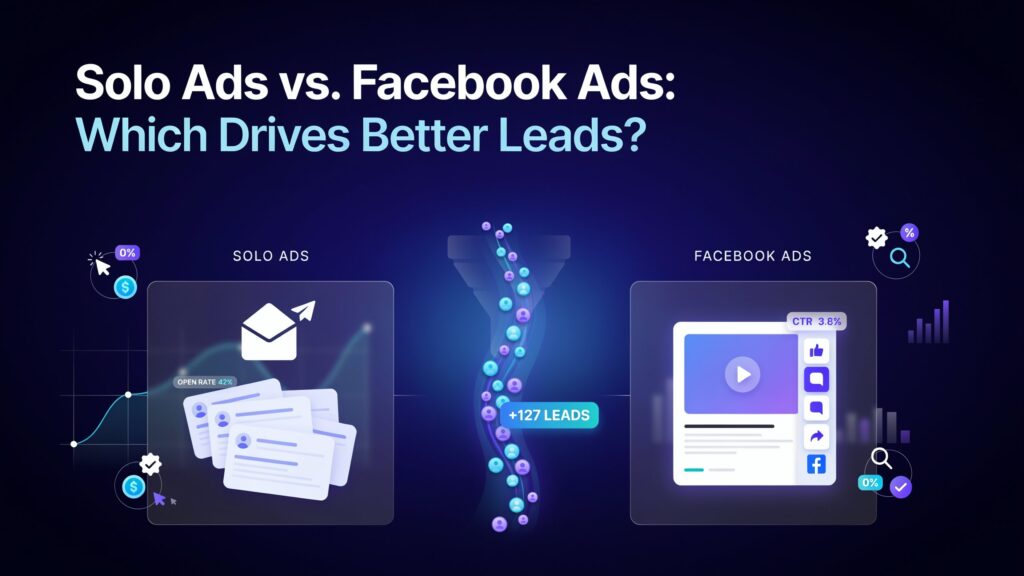
Choosing the right traffic source can make a major difference in your lead-generation results. Solo ads vs facebook ads is a common comparison among affiliate marketers, coaches, digital product sellers, and online businesses looking for qualified prospects.
Both strategies can generate leads, but they work in very different ways. Solo ads leverage established email audiences, while Facebook Ads use detailed targeting to reach specific users based on demographics, interests, behaviors, and other signals.
So, which option is better? The answer depends on your goals, budget, funnel, and ability to optimize campaigns. Let’s compare them across the factors that matter most.
Table of Contents
How Solo Ads and Facebook Ads Work
Before comparing results, it is important to understand how each advertising model works.
With solo ads, you pay a vendor or list owner to send your
to their subscribers. The vendor’s audience has already opted into an email list, usually around a specific niche such as online marketing, personal development, health, business, or investing.
For example, imagine you sell an affiliate marketing course. Instead of building an audience from scratch, you could purchase 500 clicks from a solo ads vendor whose subscribers are interested in making money online. The vendor sends your email or advertisement to those subscribers, directing interested people to your landing page.
Facebook Ads work differently. You create an advertisement inside Meta’s advertising platform and select an audience using available targeting options. Your ad can appear in Facebook and Instagram placements, depending on your campaign settings.
For example, the same affiliate marketer could create a Facebook campaign targeting people interested in entrepreneurship or digital marketing. The advertiser pays based on the campaign’s delivery and optimization model rather than purchasing a predetermined number of clicks from an email list.
This fundamental difference affects speed, control, targeting, and lead quality.
Solo Ads vs Facebook Ads: Targeting and Audience Control
One of the biggest differences in solo ads vs facebook ads is how advertisers access their audiences.
Solo ads generally give you access to an existing email audience. You select a vendor based on their niche, reputation, traffic quality, and historical performance. You typically have less control over individual subscriber characteristics.
Facebook Ads provide much more granular audience control. Depending on the campaign and available targeting features, advertisers can work with demographic information, interests, behaviors, custom audiences, lookalike audiences, website visitors, and engagement data.
Consider a business selling a beginner photography course.
With a solo ad campaign, the business might purchase traffic from a photography-related email list. The audience is already gathered by the vendor, so the advertiser relies heavily on the vendor’s ability to maintain a relevant and responsive list.
With Facebook Ads, the business can build campaigns around specific audience segments and test different creative concepts. It can also use website and engagement data to create additional campaigns.
However, more control does not automatically mean better results. Poor targeting or weak advertising creative can still produce expensive leads.
The best option depends on whether you value speed and access to an established audience or granular audience control and testing flexibility.
Solo Ads vs Facebook Ads: Lead Quality and Conversion Potential
Lead quality is where solo ads vs facebook ads becomes particularly interesting.
A solo ad subscriber has already taken an action to join an email list. This can indicate an existing interest in a particular subject. If the list is highly relevant to your offer, the traffic can be valuable.
For example, an email list focused on affiliate marketing may contain subscribers actively looking for tools, training, or strategies related to affiliate marketing. A relevant offer can therefore attract highly interested visitors.
However, not every email list has the same quality. Some lists may contain inactive subscribers, poorly targeted contacts, or people who receive large volumes of promotional emails. This is why choosing a reputable solo ads vendor matters.
Facebook users, on the other hand, may not be actively looking for your product when they see your advertisement. They could be browsing their feed, watching videos, or interacting with friends.
This means your ad must create enough interest to interrupt their normal browsing behavior.
For instance, a Facebook ad offering a free guide can attract someone who has never heard of your business. If the landing page and follow-up sequence are effective, that cold visitor can eventually become a qualified lead.
In practical terms, solo ads can provide access to an already-established niche audience, while Facebook Ads can help advertisers discover and build new audiences.
Cost, Budget, and Campaign Scalability
Budget is another major consideration when comparing these traffic sources.
Solo ads are often straightforward to budget because vendors may sell traffic based on a specific number of clicks. If you purchase 500 clicks at an agreed price, you have a relatively clear idea of the traffic volume you are buying.
Suppose a vendor charges $250 for 500 clicks. Your initial traffic cost is easy to calculate. You can then measure how many leads and sales those clicks generate.
Facebook Ads operate differently. Your results depend on factors such as audience size, competition, ad quality, campaign objective, bidding environment, landing page performance, and conversion rate.
A small campaign might begin with $10 to $30 per day. Once the advertiser identifies a profitable combination of audience, creative, and offer, the campaign can potentially be scaled.
For example:
- Ad spend: $300
- Leads generated: 100
- Cost per lead: $3
- Sales generated: 10
- Revenue: $600
The campaign produces a $300 gross difference before other business costs.
With either strategy, the cheapest click is not necessarily the best click. The important measurement is the value generated by the traffic.
Speed, Testing, and Optimization
Speed can be an important advantage for marketers who want to test an offer quickly.
A solo ad campaign can potentially send traffic shortly after the campaign has been scheduled with the vendor. This makes it useful for testing a landing page, lead magnet, webinar registration page, or email funnel.
Imagine that an affiliate marketer has created a new lead magnet. Instead of waiting weeks to build organic traffic, the marketer can purchase a targeted traffic campaign and quickly collect data.
Facebook Ads can also generate data quickly, but campaign optimization often requires more testing. Advertisers may need to experiment with headlines, images, videos, audiences, landing pages, offers, and campaign objectives.
A useful testing process might look like this:
- Create two landing page variations.
- Send comparable traffic to each page.
- Measure opt-in rates.
- Identify the stronger version.
- Test different offers or follow-up sequences.
- Scale the winning combination.
This data-driven approach is one of the biggest advantages of paid social advertising.
However, solo ads can also be valuable for testing. If the traffic is relevant and the vendor provides reliable reporting, marketers can quickly evaluate whether an offer attracts attention.
Solo Ads vs Facebook Ads: Which Is Better for Affiliate Marketing?
For affiliate marketers, solo ads vs facebook ads can have very different implications.
Solo ads can be attractive because affiliate marketers can access an existing audience without first building a large social media following. A marketer can send targeted traffic to a landing page, collect leads, and continue nurturing those leads through email.
For example, an affiliate marketer promoting an email marketing platform could create a free checklist titled “10 Email Marketing Mistakes Beginners Should Avoid.” Traffic from a relevant solo ad campaign goes to the opt-in page. New subscribers receive the checklist and enter an automated email sequence containing useful educational content and relevant product recommendations.
Facebook Ads can provide another route. The marketer could promote the same checklist to a carefully selected audience, collect leads, and use follow-up campaigns to nurture prospects.
The major difference is the traffic acquisition mechanism.
Solo ads depend heavily on the quality and relevance of the vendor’s email audience. Facebook Ads depend heavily on targeting, creative, campaign optimization, and the advertiser’s ability to manage the platform.
Affiliate marketers should therefore evaluate the entire funnel rather than judging a traffic source by clicks alone.
Measuring ROI and Choosing the Right Strategy
The most important part of solo ads vs facebook ads is not simply determining which platform has cheaper traffic. It is determining which traffic produces better business results.
Track metrics such as:
- Cost per click
- Cost per lead
- Landing page conversion rate
- Email open rate
- Email click-through rate
- Sales conversion rate
- Customer acquisition cost
- Average customer value
- Return on ad spend
Consider this example.
Campaign A generates 100 leads at $2 per lead. Campaign B generates 100 leads at $4 per lead.
At first glance, Campaign A appears better. But suppose Campaign A produces only two customers, while Campaign B produces ten customers. The higher-cost leads may actually be much more valuable.
This is why marketers should connect their traffic campaigns to their complete sales funnel.
If your primary goal is quickly accessing a niche email audience, solo ads may be worth testing. If your priority is granular audience targeting, creative experimentation, and long-term campaign optimization, Facebook Ads may be more suitable.
There is also no rule that says you must choose only one. An experienced marketer can test both channels and allocate more budget to whichever produces the strongest qualified leads and profitable customers.
Conclusion
There is no universal winner in the solo ads vs facebook ads debate. Each traffic source has distinct strengths.
Solo ads can provide fast access to an existing niche audience and may work well for marketers who have a strong landing page, email funnel, and relevant offer. Facebook Ads offer extensive targeting and creative-testing opportunities, making them useful for businesses that want to build and optimize scalable acquisition campaigns.
The smartest approach is to test both strategies with controlled budgets, track the complete customer journey, and focus on revenue rather than vanity metrics.
Instead of asking which traffic source is universally better, ask a more useful question: Which channel produces the most valuable customers for your specific offer and funnel?
Frequently Asked Questions
Are solo ads good for beginners?
Yes. Solo ads can be relatively simple to test because the advertiser can purchase a defined amount of traffic from a vendor. Beginners should start with a small campaign and carefully track leads, conversions, and sales.
How much should I spend on my first campaign?
Start with an amount you can afford to test without putting pressure on your business. The goal of an initial campaign should be collecting reliable performance data rather than immediately maximizing profit.
What makes a good advertising audience?
A good audience is relevant to your offer, active enough to respond to marketing messages, and likely to have a genuine problem that your product or service solves.
How can I improve my lead conversion rate?
Improve the alignment between your advertisement, landing page, offer, and follow-up sequence. A clear benefit, strong call to action, fast-loading page, and relevant lead magnet can all help.
Should I use paid traffic for an affiliate offer?
Paid traffic can work for affiliate marketing when the advertising platform permits the offer and the campaign follows its policies. Always check the current advertising rules before launching a campaign.