
When running a paid email traffic campaign, it is easy to become obsessed with the number of clicks. A campaign that generates hundreds or thousands of visitors can look impressive, but clicks alone do not necessarily create revenue.
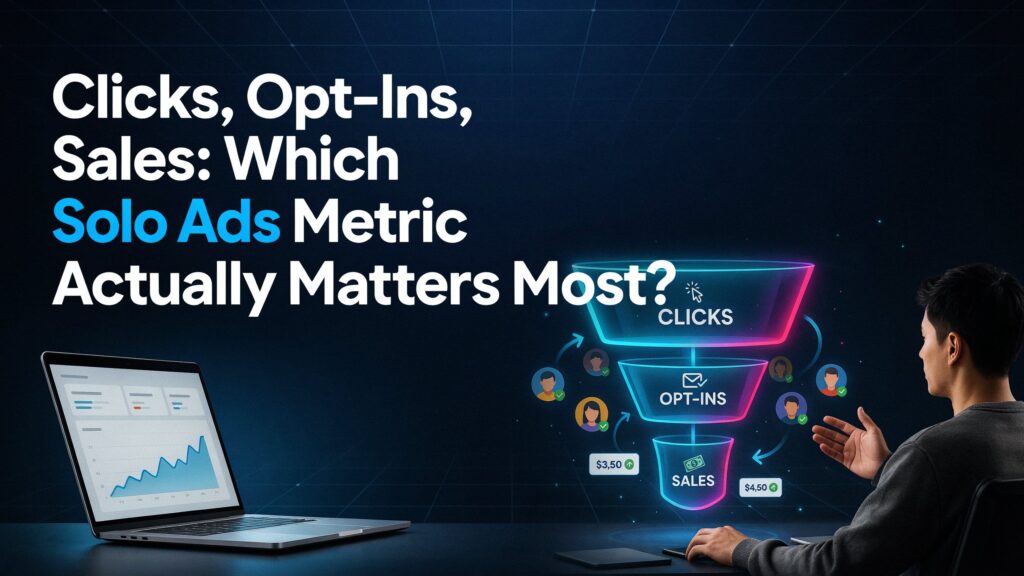
Understanding solo ads Clicks, Opt-Ins, Sales helps marketers evaluate what is happening at every stage of the funnel. Clicks show whether people are responding to the message, opt-ins reveal whether the landing page creates enough interest, and sales ultimately show whether the entire campaign is producing financial results.
So, which metric matters most? The answer depends on your campaign objective—but understanding how these three metrics work together is more valuable than focusing on any single number.
Table of Contents
Why Clicks Alone Don't Tell the Full Story
Clicks are one of the easiest campaign numbers to notice. They show that people responded to the email and visited your offer.
However, a high click count does not automatically mean a successful campaign.
Imagine two campaigns:
Campaign A
- 500 clicks
- 200 opt-ins
- 10 sales
Campaign B
- 500 clicks
- 50 opt-ins
- 2 sales
Both campaigns generated exactly 500 clicks. Yet Campaign A clearly produced more valuable results.
This demonstrates why solo ads Clicks, Opt-Ins, Sales should be viewed as connected stages rather than isolated numbers.
Clicks are useful because they tell you whether your initial message is generating curiosity. But they cannot tell you whether visitors like the offer, trust the landing page, or eventually become customers.
Think of clicks as the beginning of the funnel—not the final goal.
Understanding Solo Ads Clicks, Opt-Ins, Sales
The easiest way to understand solo ads Clicks, Opt-Ins, Sales is to view them as three stages of the customer journey.
Clicks
A click occurs when someone responds to the promotional email and visits your landing page.
Clicks can indicate:
- Interest in the subject
- Relevance of the email
- Curiosity about the offer
- Effectiveness of the call to action
Opt-Ins
An opt-in happens when a visitor provides their contact information, usually an email address.
This tells you that the visitor found enough value or relevance in your offer to take another step.
Sales
A sale occurs when a prospect purchases your product or service.
This is where traffic turns into revenue.
For example:
1,000 clicks → 300 opt-ins → 25 sales
Each stage tells you something different about campaign performance.
If clicks are high but opt-ins are low, your landing page or offer may need improvement. If opt-ins are high but sales are low, the problem may be your follow-up sequence, sales page, pricing, or product-market fit.
Understanding the entire journey gives you a much clearer picture than looking at clicks alone.
How Solo Ads Clicks, Opt-Ins, Sales Reveal Funnel Problems
One major advantage of tracking solo ads Clicks, Opt-Ins, Sales is that the numbers can help you locate the weakest stage of your funnel.
Consider this example:
1,000 clicks → 50 opt-ins → 1 sale
The campaign attracted significant traffic, but the funnel lost most visitors before they subscribed.
Now compare it with:
1,000 clicks → 400 opt-ins → 2 sales
Here, the landing page performs much better, but the sales process may have a problem.
This difference is extremely important.
If you only look at the number of clicks, both campaigns appear successful. Once you analyze the complete funnel, you can see that they have completely different problems.
You can calculate several useful rates:
Opt-In Conversion Rate
Opt-ins ÷ Visitors × 100
If 1,000 visitors produce 300 opt-ins:
300 ÷ 1,000 × 100 = 30%
Sales Conversion Rate
Sales ÷ Visitors × 100
If 1,000 visitors produce 20 sales:
20 ÷ 1,000 × 100 = 2%
These calculations help you identify where optimization should happen.
When Clicks Are the Most Important Metric
There are situations where clicks deserve significant attention.
If your main goal is to generate website visitors, promote content, or send prospects into another funnel, click volume can be an important indicator.
For example, suppose you are testing two email headlines.
Headline A:
“Discover Our New Marketing Guide”
Headline B:
“5 Marketing Mistakes That Could Be Costing You Leads”
If Headline B generates substantially more clicks, you have evidence that the second message creates stronger initial interest.
However, you should not stop your analysis there.
A headline that generates more clicks but attracts poorly matched visitors may actually produce fewer leads and sales.
Therefore, use click data to evaluate your initial message, not as the sole measure of business success.
The ideal scenario is a campaign that generates relevant clicks that continue through the rest of the funnel.
When Opt-Ins Become More Important Than Clicks
If your primary goal is building an email list, opt-ins can be more meaningful than raw click volume.
Imagine you spend $500 on a campaign.
Campaign A produces:
- 1,000 visitors
- 100 subscribers
Campaign B produces:
- 700 visitors
- 210 subscribers
Campaign B generated fewer visitors but more than twice as many leads.
If your business depends on nurturing an email list, Campaign B may be considerably more valuable.
This is why solo ads Clicks, Opt-Ins, Sales should always be evaluated according to your campaign objective.
To improve opt-ins, examine:
- Your lead magnet
- Landing page headline
- Call to action
- Form length
- Page speed
- Mobile experience
- Trust signals
- Message-to-page consistency
For example, if the email promises a free checklist but the landing page barely mentions that checklist, visitors may hesitate to subscribe.
Small changes to the landing page can sometimes make a substantial difference in conversion rate.
Why Solo Ads Clicks, Opt-Ins, Sales Should Be Connected
The most useful way to analyze solo ads Clicks, Opt-Ins, Sales is to connect the three metrics together.
Think about the funnel like this:
Clicks → Opt-Ins → Sales
Each stage depends on the previous one.
You cannot generate sales from visitors who never click. You cannot generate many sales from a funnel that converts very few visitors into leads. And you cannot build a sustainable campaign if your leads never become customers.
Consider this example:
Campaign A
1,000 clicks → 300 opt-ins → 30 sales
Campaign B
1,000 clicks → 100 opt-ins → 25 sales
Campaign A has a stronger opt-in rate, but both campaigns generate relatively strong sales numbers.
Now imagine Campaign C:
1,000 clicks → 500 opt-ins → 3 sales
At first, Campaign C looks impressive because it produces a huge number of subscribers. But the low number of sales raises another question: Are the leads properly targeted? Is the follow-up effective? Is the offer compelling?
The best campaign is not necessarily the one with the most clicks or subscribers.
It is the campaign that efficiently moves relevant prospects through the entire funnel toward your business objective.
The Metric That Ultimately Matters Most
If your goal is to build a profitable business, revenue and return on investment ultimately matter most.
Clicks and opt-ins are important leading indicators, but they do not pay your bills by themselves.
Suppose you run two campaigns.
Campaign A
- Cost: $300
- 1,000 clicks
- 250 opt-ins
- $200 revenue
Campaign B
- Cost: $300
- 700 clicks
- 150 opt-ins
- $600 revenue
Campaign A looks better if you only care about traffic and subscribers.
Campaign B is clearly stronger financially.
This is the critical lesson behind solo ads Clicks, Opt-Ins, Sales: every metric has a purpose, but your final evaluation should connect campaign performance to your actual business goal.
For a list-building campaign, subscriber acquisition may be the primary KPI. For an ecommerce or affiliate campaign, revenue and profit may matter more.
Track everything, but optimize according to the result that matters to your business.
Conclusion
There is no single number that can explain the entire performance of a solo ad campaign.
Clicks tell you whether your message generates interest. Opt-ins show whether your landing page and offer persuade visitors to become leads. Sales demonstrate whether your complete marketing funnel can turn those leads into revenue.
The smartest approach is to analyze solo ads Clicks, Opt-Ins, Sales together rather than treating them as separate statistics.
Start by identifying your campaign objective. Then track each stage, calculate conversion rates, find the biggest drop-off, and improve that part of the funnel.
Ultimately, the metric that matters most is the one connected to your business goal—but the other metrics help explain why you are getting that result.
Frequently Asked Questions
What should I track in a solo ad campaign?
Track delivered clicks, unique visitors, opt-ins, conversion rates, sales, revenue, cost per lead, and return on investment. These numbers provide a broader picture of campaign performance.
Why can a campaign have many clicks but few sales?
High traffic does not guarantee that visitors are interested in buying. The issue could be audience targeting, the landing page, the offer, pricing, trust, or the follow-up sequence.
How do I calculate my opt-in conversion rate?
Divide the number of subscribers by the number of unique visitors and multiply the result by 100. For example, 100 subscribers from 500 visitors equals a 20% conversion rate.
Should I focus on traffic volume or traffic quality?
Traffic quality is generally more valuable for conversion-focused campaigns. Relevant visitors are more likely to subscribe, engage, and eventually purchase.
What is a good conversion rate?
There is no universal number because conversion rates vary by niche, audience, offer, landing page, and campaign objective. Compare your results over time and focus on improving your own baseline.