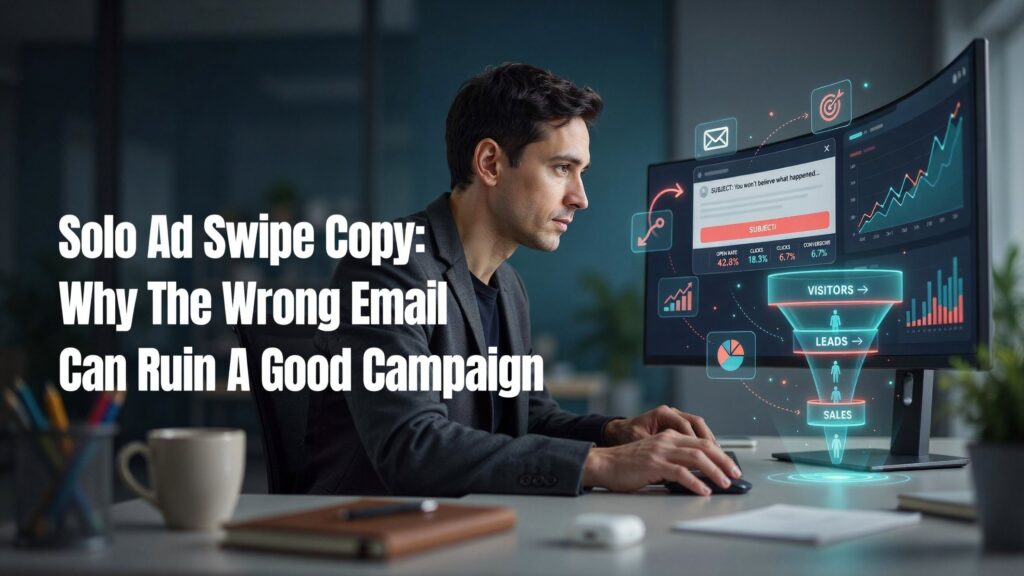
A solo ad campaign can have a great offer, an attractive landing page, and a strong funnel, yet still produce disappointing results because of one overlooked element: the email swipe copy. The email is often the first thing a prospect sees, so its wording can determine whether they click or ignore the offer.
Understanding solo ads metrics can help you identify whether the problem is your email message, targeting, landing page, or overall campaign strategy. Instead of guessing why a campaign is underperforming, marketers can use measurable data to find the weak point and make smarter improvements.
Here are seven important ways your swipe copy can influence campaign performance—and how to fix common problems.
Table of Contents
Your Subject Line May Be Killing Your Open Rate
The subject line is the first part of your email that a subscriber sees. If it fails to create curiosity or communicate relevance, the rest of your carefully written swipe copy may never get read.
A common mistake is making the subject line too generic.
For example:
Weak:
“Check Out This Great Opportunity”
Stronger:
“3 Simple Ways to Improve Your Affiliate Funnel”
The second example immediately communicates a potential benefit and gives the reader a reason to continue.
When reviewing solo ads metrics, pay attention to the relationship between the number of emails sent, opens, clicks, and conversions. If engagement is weak from the beginning, the subject line and opening message deserve attention.
Avoid exaggerated claims, excessive punctuation, and misleading promises. Your subject line should create curiosity without making a promise that the landing page cannot fulfill.
A good subject line gets attention. A good email then earns the click.
How Solo Ads Metrics Expose Weak Email Copy
Numbers can reveal problems that are difficult to spot by simply reading an email.
Suppose a campaign generates 500 delivered emails, 150 clicks, but only two conversions. At first glance, the campaign appears to have generated significant interest. However, the conversion data tells a different story.
This is where solo ads metrics become useful.
Consider these measurements:
- Delivery rate
- Open rate
- Click-through rate
- Landing-page conversion rate
- Cost per lead
- Cost per acquisition
- Revenue generated
Imagine two campaigns:
Campaign A:
500 clicks → 125 leads
Campaign B:
500 clicks → 25 leads
Both campaigns generated the same number of clicks, but Campaign A produced five times more leads.
That difference suggests something beyond traffic volume is affecting performance. The email message, landing page, offer, audience, or combination of these factors may be responsible.
The important lesson is simple: never evaluate an email only by how many clicks it generates. Look at what happens after those clicks.
Use Solo Ads Metrics to Find the Real Conversion Problem
One of the biggest advantages of tracking solo ads metrics is that you can break the customer journey into individual stages.
Think of your campaign as a funnel:
Email → Click → Landing Page → Opt-In → Follow-Up → Sale
If the funnel performs well at one stage and suddenly drops at another, you have a useful clue.
For example:
- 1,000 emails delivered
- 300 clicks
- 280 landing-page visitors
- 20 opt-ins
- 2 sales
The email successfully generated interest because 300 people clicked. However, only 20 visitors subscribed.
That suggests the landing page or offer may be the bigger problem.
Now consider a different result:
- 1,000 emails delivered
- 40 clicks
- 35 landing-page visitors
- 20 opt-ins
Here, the landing page converts extremely well, but the email generates very few clicks. The swipe copy or audience targeting deserves closer examination.
This type of analysis prevents you from making the wrong optimization.
Instead of saying, “The campaign doesn’t work,” identify exactly where prospects stop moving through the funnel.
Your Email Promise Must Match the Offer
One of the easiest ways to damage a campaign is to create a disconnect between the email and the landing page.
Imagine your email says:
“Discover a free 5-step system for building your first affiliate funnel.”
The reader clicks expecting a free five-step system. Instead, they arrive on a page promoting an unrelated paid product.
Even if the product is excellent, the visitor may feel misled.
The result can be:
- Lower trust
- Higher bounce rates
- Fewer opt-ins
- More complaints
- Poorer conversion rates
A strong swipe should prepare the reader for what happens next.
If the landing page offers a free checklist, mention the checklist. If the offer is a webinar, explain what the webinar covers. If the visitor needs to complete an additional step, make that clear.
This alignment makes the transition from email to landing page feel natural.
For example:
Email:
“Download our free checklist for planning your next affiliate campaign.”
Landing page:
“Get Your Free Affiliate Campaign Planning Checklist.”
The message remains consistent from the first click to the final conversion.
Don't Overload Your Swipe With Too Much Information
Another common mistake is trying to explain the entire offer inside one email.
A solo ad swipe does not need to be a complete sales page.
Its primary job is to attract the right person’s attention, create interest, and encourage an appropriate next action.
For example, instead of writing several paragraphs about every feature of a product, focus on:
- The problem
- The desired outcome
- A compelling benefit
- A reason to take action
- A clear call to action
Suppose you are promoting an affiliate marketing training program.
Instead of explaining 15 modules, dozens of lessons, and every bonus, your email could focus on one specific problem:
“Struggling to turn your website visitors into leads? This free training shows three simple funnel changes that can help improve your conversion process.”
The reader now understands the problem and the potential benefit without being overwhelmed.
Your solo ads metrics can help you determine whether shorter, clearer messaging is producing better engagement than lengthy copy.
Test different approaches rather than assuming longer copy automatically means better copy.
Let Solo Ads Metrics Guide Your Swipe Testing
Testing should be based on evidence rather than personal preference.
You might believe that a particular headline is excellent, but your audience may respond differently.
This is why solo ads metrics should be part of your testing process.
Create two versions of your email with one significant difference.
Version A
Subject:
“Want More Affiliate Leads?”
Version B
Subject:
“3 Ways to Turn More Visitors Into Affiliate Leads”
Keep the rest of the campaign as consistent as possible. Then compare the results.
You can test:
- Subject lines
- Opening sentences
- Main benefits
- Calls to action
- Email length
- Urgency
- Different audience segments
Avoid changing everything at once. If the subject line, headline, offer, and CTA all change simultaneously, you will not know which adjustment caused the improvement.
A structured testing process allows you to turn campaign data into actionable insights.
Over several campaigns, these small discoveries can help you develop swipe copy that consistently performs better.
Write for the Right Audience, Not Everyone
Even excellent copy can fail when it reaches the wrong audience.
Suppose your offer is advanced email automation software. Your email is written for experienced marketers, but the traffic source mainly reaches people who are just beginning to learn online marketing.
The message may generate some curiosity, but the offer will not feel relevant enough to produce strong conversions.
Before writing your swipe, identify:
- Who is the ideal prospect?
- What problem are they experiencing?
- What result do they want?
- What language do they use?
- What objections might they have?
- What level of knowledge do they already possess?
Then write specifically for that person.
For example, an email aimed at beginners might say:
“Not sure how to start building an email list? Here’s a simple framework you can follow.”
An email aimed at experienced marketers might say:
“Already generating leads but struggling with subscriber-to-customer conversions? See how a few funnel adjustments can improve the next stage of your campaign.”
The offer can remain similar, but the messaging changes according to the audience.
Reviewing solo ads metrics alongside audience information can help you determine whether low performance is caused by poor copy or poor targeting.
Conclusion
A strong solo ad campaign requires more than good traffic and an attractive offer. The email swipe is the bridge between the audience and your landing page, and a weak message can prevent interested prospects from taking the next step.
Use solo ads metrics to understand where people are dropping out of your funnel. Look at clicks, conversions, opt-ins, and sales rather than focusing on one number.
Keep your promise consistent, make your message easy to understand, test different approaches, and write for a specific audience. Most importantly, let actual campaign data—not assumptions—guide your decisions.
When your swipe copy and offer work together, every click has a better opportunity to become a meaningful lead or customer.
Frequently Asked Questions
What is solo ad swipe copy?
Solo ad swipe copy is the email message used by a traffic provider to promote your offer to their email subscribers. It is designed to attract attention and encourage interested readers to click.
What makes an email swipe effective?
Effective swipe copy is relevant, concise, benefit-focused, and aligned with the landing page. It should give the reader a clear reason to continue without making misleading promises.
How long should a promotional email be?
There is no universal ideal length. The email should contain enough information to create interest while avoiding unnecessary details. Testing different lengths can help identify what works for your audience.
Should I write my own swipe copy?
You can write your own copy if you understand your audience and offer. You can also collaborate with the traffic provider if they have experience creating promotional emails for their subscribers.
Why can an email generate clicks but few sales?
Clicks show interest, but they do not guarantee that visitors will purchase. The problem may be the landing page, offer, pricing, audience targeting, trust factors, or follow-up sequence.